
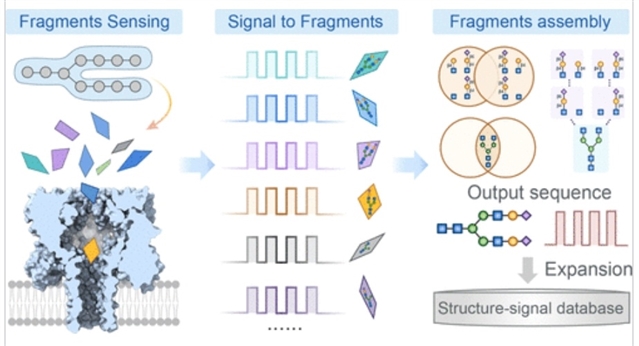
近日,中国科学院上海药物研究所高召兵团队研究了基于片段重组策略的纳米孔聚糖测序。相关论文于2026年3月10日发表在《美国化学会志》上。
纳米孔技术已成为聚糖测序的重要平台,可实现单个寡糖的实时读取。此前研究组提出了三种基于纳米孔的聚糖解码概念性策略,包括水解测序、链测序和组装测序。然而,通过片段重构聚糖完整序列的可行性尚未得到验证。
该研究对基于纳米的孔片段化-重装配策略进行了概念验证评估。完整复合聚糖经水解产生片段,这些片段通过纳米孔突变体进行检测,并利用训练好的分类器将其匹配至候选结构。通过集合论运算整合预测结果:交集识别共享结构元件,并集整合分支特异性特征,差集则排除不相容的组合。通过上述片段整合步骤,成功重构了模型N-聚糖的分支结构。在该测序体系下,分支型聚糖的重构保真度达93.71%,且在存在结构相似聚糖、成分复杂性及生物背景干扰时仍保持稳健性,彰显其实际应用潜力。
该测序流程可广泛适用于各类聚糖,并能适配不同纳米孔系统。有别于需要完全覆盖片段的传统方法,该策略表明,在减少测量工作量和数据库需求的同时,基于部分片段信息亦可实现连贯的结构推断。据我们所知,这是首个基于纳米孔实现分支型聚糖单分子测序的实证研究。结合前期对水解和链测序策略的验证,本研究完成了模块化纳米孔聚糖解码框架的初步验证。
附:英文原文
Title: Nanopore-Based Glycan Sequencing via a Fragmentation-Reassembly Strategy
Author: Bingqing Xia, Guangda Yao, Jiamei Fan, Fangyu Wei, Jianling Tan, Pingan Li, Liuqing Wen, Zhaobing Gao
Issue&Volume: March 10, 2026
Abstract: Nanopore have emerged as a promising platform for glycan sequencing, enabling the real-time readout of individual oligosaccharides. Previously, we proposed three conceptual nanopore-based strategies for glycan decoding including hydrolysis sequencing, strand sequencing, and assembly sequencing. However, the feasibility of reconstructing the full sequence of a glycan from fragments has not yet been established. Here, we performed a proof-of-concept evaluation of the nanopore-based fragmentation-reassembly strategy. Intact complex glycans were hydrolyzed into fragments, which were detected by a nanopore mutant and assigned to structural candidates using a trained classifier. The resulting predictions were integrated through set-theoretic operations, where intersections identified shared structural elements, unions incorporated branch-specific features, and set differences removed incompatible combinations. Through these fragment-integration steps, the branch structure of the model N-glycan was reconstructed. Under this sequencing system, we achieved 93.71% reconstruction fidelity for branched glycans, and the approach remained robust in the presence of structurally similar glycans, compositional complexity, and biological background, highlighting its potential for real-world applications. The sequencing workflow could be broadly applicable across glycan types and adaptable to different nanopore systems. Unlike approaches requiring exhaustive fragment coverage, this strategy showed that coherent structural inference may be possible from partial fragment information while reducing measurement effort and database demands. To the best of our knowledge, this represents the first demonstration of nanopore-based single-molecule sequencing of branched glycans. Together with prior demonstrations of hydrolysis and strand strategies, this work completes the initial validation of a modular nanopore-based framework for glycan decoding.
DOI: 10.1021/jacs.5c22760
Source: https://pubs.acs.org/doi/abs/10.1021/jacs.5c22760
JACS:《美国化学会志》,创刊于1879年。隶属于美国化学会,最新IF:16.383
官方网址:https://pubs.acs.org/journal/jacsat
投稿链接:https://acsparagonplus.acs.org/psweb/loginForm?code=1000