
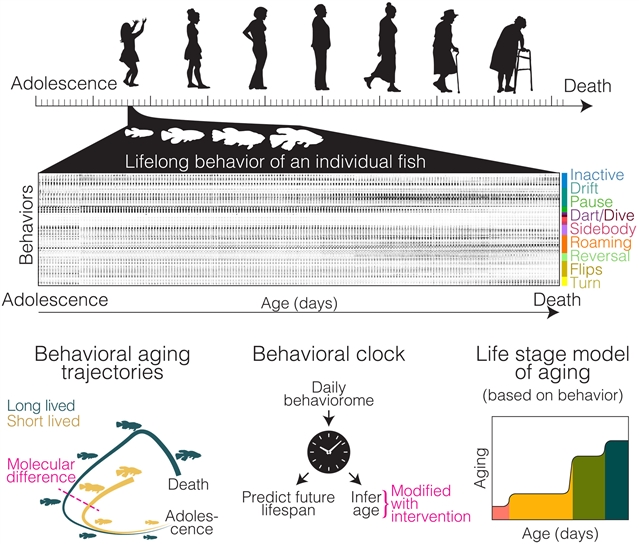
该课题组人员创建了一个平台,对非洲鳉鱼从青春期到死亡的整个自然生命周期进行高分辨率的连续行为跟踪。该课题组人员发现动物遵循不同的个体衰老轨迹。长寿动物的行为与短命动物明显不同,甚至在生命相对较早的时候也是如此,这与器官特异性转录组变化有关。机器学习模型仅根据一个人年轻时的行为,就能准确地推断出年龄,甚至预测出个人未来的寿命。最后,研究团队发现动物在成年期经历了一系列稳定和刻板的行为阶段,并伴有突变,揭示了衰老结构的精确结构。
研究人员表示,绘制脊椎动物个体在整个生命周期中的行为图谱,可以为了解衰老的终生过程提供一个前所未有的视角。
附:英文原文
Title: Lifelong behavioral screen reveals an architecture of vertebrate aging
Author: Claire N. Bedbrook, Ravi D. Nath, Libby Zhang, Scott W. Linderman, Anne Brunet, Karl Deisseroth
Issue&Volume: 2026-03-12
Abstract: Mapping behavior of individual vertebrate animals across lifespan could provide an unprecedented view into the lifelong process of aging. We created a platform for high-resolution continuous behavioral tracking of the African killifish across natural lifespan from adolescence to death. We found that animals follow distinct individual aging trajectories. The behaviors of long-lived animals differed markedly from those of short-lived animals, even relatively early in life, and were linked to organ-specific transcriptomic shifts. Machine-learning models accurately inferred age and even forecasted an individual’s future lifespan, given only behavior at a young age. Finally, we found that animals progressed through adulthood in a sequence of stable and stereotyped behavioral stages with abrupt transitions, revealing precise structure for an architecture of aging.
DOI: aea9795
Source: https://www.science.org/doi/10.1126/science.aea9795