
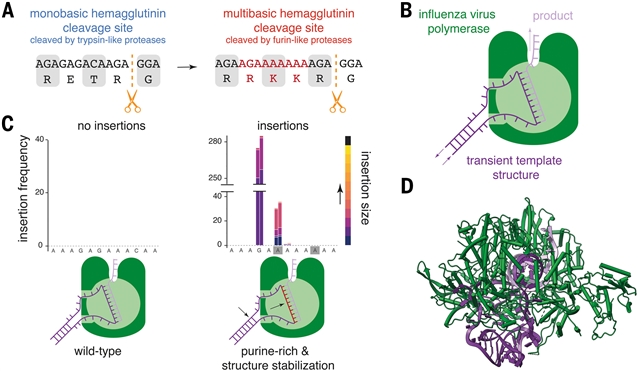
研究小组发现瞬时H5 RNA结构,预测会在富含嘌呤的序列上捕获流感病毒聚合酶,驱动核苷酸插入,为RNA结构参与MBCS获取提供了经验证据。在H6血凝素中引入h5样序列和结构导致产生MBCS的插入。他们的研究结果表明,H5 HPAIV出现背后的核苷酸插入是由RNA结构驱动的多样性产生机制产生的,这也可能发生在其他RNA病毒主题中。
据了解,高致病性禽流感病毒主题(HPAIVs)源于H5和H7低致病性禽流感病毒主题(LPAIVs)。虽然在血凝素基因中插入一个furin可切割的多碱基切割位点(MBCS)在几十年前就被确定为LPAIV向HPAIV过渡的遗传基础,但插入发生的机制尚不清楚。
附:英文原文
Title: Polymerase trapping as the mechanism of H5 highly pathogenic avian influenza virus genesis
Author: Mathis Funk, Monique I. Spronken, Roy M. Hutchinson, Benoit Arragain, Pauline Juyoux, Theo M. Bestebroer, Anja C. M. de Bruin, Alexander P. Gultyaev, Ron A. M. Fouchier, Stephen Cusack, Aartjan J. W. te Velthuis, Mathilde Richard
Issue&Volume: 2026-03-12
Abstract: Highly pathogenic avian influenza viruses (HPAIVs) derive from H5 and H7 low pathogenic avian influenza viruses (LPAIVs). Although insertion of a furin-cleavable multibasic cleavage site (MBCS) in the hemagglutinin gene was identified decades ago as the genetic basis for the LPAIV-to-HPAIV transition, the mechanisms underlying the occurrence of insertion are unknown. Here, we show that transient H5 RNA structures, predicted to trap the influenza virus polymerase on purine-rich sequences, drive nucleotide insertions, providing empirical evidence of RNA structure involvement in MBCS acquisition. Introduction of H5-like sequences and structures into an H6 hemagglutinin resulted in MBCS-yielding insertions. Our results show that nucleotide insertions that underlie H5 HPAIV emergence result from an RNA structure–driven diversity-generating mechanism, which could also occur in other RNA viruses.
DOI: adr6632
Source: https://www.science.org/doi/10.1126/science.adr6632