
中国南方中晚更新世丹尼索瓦人和未解人属,这一成果由中国科学院Fu, Qiaomei团队经过不懈努力而取得。2026年11月25日出版的《自然》杂志发表了这一最新研究成果。
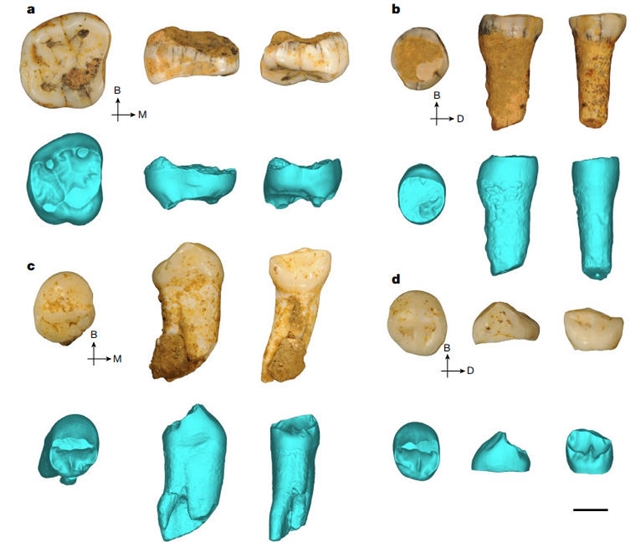
本文报道了在广西川山东和龙川东两个洞穴遗址中发现的一组新发现的古人类化石(4颗分离的牙齿,分别超过100.8万年和104.5-42.6万年)。综合形态学和古蛋白质组学分析揭示了至少两个不同谱系的表型和分子多样性。由于其牙齿形态和单氨基酸多态性与来自哈尔滨、澎湖、卞福洞和阿尔泰的丹尼索瓦人极其相似,一个谱系(龙川洞)被归属于一个丹尼索瓦人亲缘群体。另一个谱系,以川山东人族为代表,是一个未确定的古人类,因为它携带一个与人类祖先和类人猿共有的祖先变异(AMELY 179M),以及另一个与东亚中更新世直立人共有的变异(AMBN 253G),但缺乏与丹尼索瓦人相关的AMBN 273V变异(这很可能是从直立人那里遗传的)。该谱系的牙齿形态表现出多形和衍生特征的嵌合体,但没有明确的丹尼索瓦人亲缘关系。这些发现表明,在中晚更新世时期,中国的亚热带地区可能存在不同的人类种群,其中包括一个丹尼索瓦人亲缘种群和另一个未确定的古人类。
研究人员表示,分子和形态学证据越来越多地支持这样的观点,即大多数东亚中更新世至晚更新世古人类属于丹尼索瓦人1,但其他当代猿人谱系的存在仍不清楚。
附:英文原文
Title: Middle–Late Pleistocene Denisovans and unresolved Homo in southern China
Author: Xing, Song, Rao, Huiyun, Xie, Guangmao, Bai, Fan, Ge, Junyi, Bennett, E. Andrew, Wu, Zhongyou, Shao, Qingfeng, Li, Xianglei, Viola, Bence, Sun, Qiyahui, Zhou, Kai, Li, Zitao, Jiangzuo, Qigao, Zhao, Yuhao, Liu, Feng, Liu, Yingjie, Feng, Xiaotian, Lin, Qiang, Fu, Qiaomei
Issue&Volume: 2026-11-25
Abstract: Molecular and morphological evidence increasingly supports the view that most East Asian Middle to Late Pleistocene archaic Homo belong to Denisovans1, yet the presence of other contemporaneous lineages has remained unclear. Here we report a set of newly discovered hominin fossils (4 isolated teeth; more than 100.8 thousand years ago and 104.5–42.6 thousand years ago, respectively) from 2 cave sites (Chuanshandong and Longchuandong) in Guangxi, southern China. Integrated morphological and palaeoproteomic analyses reveal substantial phenotypic and molecular diversity consistent with at least two distinct lineages. One lineage (Longchuandong) is assigned to a Denisovan-affinity population, owing to its extreme similarity to Altai Denisovans with respect to dental morphology and single amino acid polymorphisms that match those of Denisovans from Harbin, Penghu, Bianfu Cave and Altai. The other lineage, represented by the Chuanshandong hominin, is an unresolved archaic Homo, as it carries an ancestral variant (AMELY 179M) shared with Homo antecessor and great apes and another variant (AMBN 253G) that is diagnostic of East Asian Middle Pleistocene Homo erectus but lacks the Denisovan-associated AMBN 273V variant (it being highly probable that this is inherited from H. erectus). Dental morphology in this lineage exhibits a mosaic of plesiomorphic and derived traits but no clear Denisovan affinity. These findings indicate that diverse hominin populations may have inhabited subtropical China during the Middle and Late Pleistocene, including a Denisovan-affinity population and another unresolved archaic Homo.
DOI: 10.1038/s41586-026-11341-6
Source: https://www.nature.com/articles/s41586-026-11341-6
Nature:《自然》,创刊于1869年。隶属于施普林格·自然出版集团,最新IF:69.504
官方网址:http://www.nature.com/
投稿链接:http://www.nature.com/authors/submit_manuscript.html