
近日,瑞士苏黎世大学教授Jinek, Martin及其研究团队研究出I型CAST系统RNA引导DNA整合的结构基础。这一研究成果发表在2026年11月25日出版的国际学术期刊《自然》上。
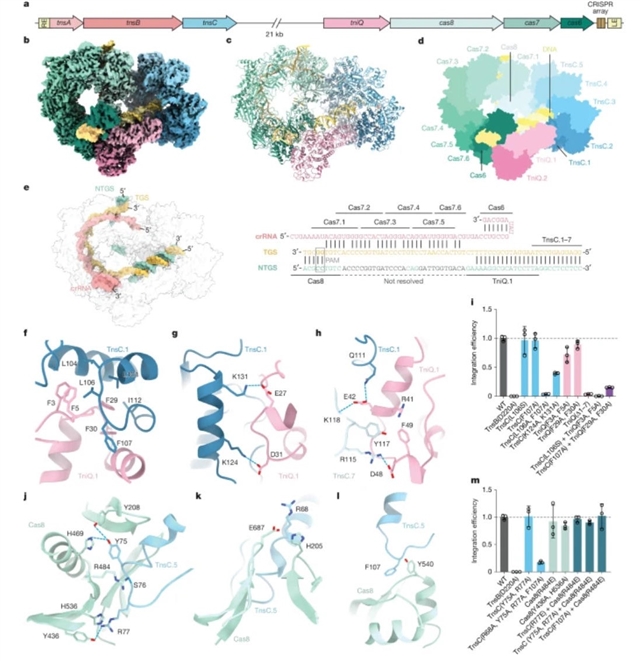
在这里,课题组人员使用低温电子显微镜进行结构分析,并通过DNA转位试验验证,以可视化PseCAST系统在一系列功能状态下,定义RNA引导DNA整合的逐步机制。PseCAST靶向和转座酶招募复合物的结构表明,由r环形成引起的级联- tniq模块的构象变化与靶DNA稳定和TnsC七聚化有关。这反过来又通过与TnsB的羧基末端尾部的保守相互作用导致TnsAB转座酶的募集。最后,1.2MDa PseCAST转座体整体复合物揭示了TnsC-TnsB和TnsB -靶- dna相互作用对TnsB催化位点构象重塑的变构耦合,激活了供体- DNA整合。总之,这些发现为I型铸型的RNA引导DNA整合建立了统一的机制蓝图,并为指导其基因组编辑应用的工程提供了结构框架。
据悉,crispr相关转座酶(cast)通过将核酸酶缺陷CRISPR-Cas系统的RNA引导靶向作用与tn7样转座体复合物的组装相结合,实现位点特异性DNA整合。了解这个复杂过程的详细机制对于将CAST系统设计成可编程的遗传工具至关重要。I-F型假互变单胞菌CAST (PseCAST)迄今在哺乳动物细胞中表现出最高的活性,并通过定向进化被广泛适应。然而,其持续的合理工程需要解决他们对转座体组装和激活的理解上的关键差距。
附:英文原文
Title: Structural basis of RNA-guided DNA integration by type I CAST systems
Author: Finocchio, Giada, Oberli, Seraina, Lampe, George D., Schmitz, Michael, Sternberg, Samuel H., Jinek, Martin
Issue&Volume: 2026-11-25
Abstract: CRISPR-associated transposases (CASTs) achieve site-specific DNA integration by combining the RNA-guided targeting action of a nuclease-deficient CRISPR–Cas system with the assembly of a Tn7-like transpososome complex1,2. Understanding the detailed mechanisms of this elaborate process is paramount to engineering CAST systems into programmable genetic tools3,4,5,6. Type I-F Pseudoalteromonas CAST (PseCAST) shows the highest activity in mammalian cells so far7 and has been adapted extensively through directed evolution8. However, its continued rational engineering requires addressing critical gaps in our understanding of transpososome assembly and activation9. Here we perform structural analyses using cryogenic electron microscopy, validated by DNA transposition assays, to visualize the PseCAST system in a series of functional states that define the stepwise mechanism of RNA-guided DNA integration. The structures of the PseCAST targeting and transposase recruitment complexes revealed that conformational changes in the Cascade–TniQ module, induced by R-loop formation, are associated with target-DNA stabilization and TnsC heptamerization. This, in turn, results in the recruitment of the TnsAB transposase by conserved interactions with the carboxy-terminal tail of TnsB. Finally, the structure of the 1.2MDa PseCAST transpososome holocomplex revealed allosteric coupling of TnsC–TnsB and TnsB–target-DNA interactions to the conformational remodelling of the TnsB catalytic site, activating donor-DNA integration. Together, these findings establish a unified mechanistic blueprint for RNA-guided DNA integration by type I CASTs and provide a structural framework to guide their engineering for genome-editing applications.
DOI: 10.1038/s41586-026-11196-x
Source: https://www.nature.com/articles/s41586-026-11196-x
Nature:《自然》,创刊于1869年。隶属于施普林格·自然出版集团,最新IF:69.504
官方网址:http://www.nature.com/
投稿链接:http://www.nature.com/authors/submit_manuscript.html