
转录暂停和伸长调节因子介导体细胞超突变,这一成果由美国康涅狄格州纽黑文耶鲁医学院Lizhen Wu小组经过不懈努力而取得。相关论文于2026年9月30日发表于国际顶尖学术期刊《自然》杂志上。
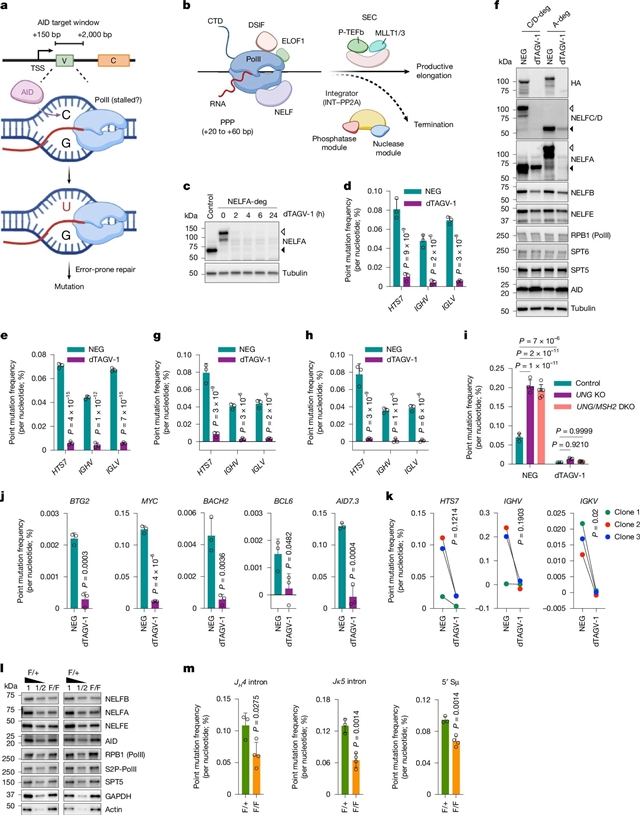
体细胞超突变(SHM)在活化B细胞免疫球蛋白基因的可变区产生点突变,以支持抗体亲和力成熟。SHM由活化诱导胞苷脱氨酶(AID)启动,这种胞苷脱氨酶的单链DNA底物被认为在RNA聚合酶II(PolII)转录过程中产生,可能是在PolII停滞的背景下。介导AID染色质招募并在SHM过程中产生其推定的停滞PolII底物的因子和机制尚不清楚。负延伸因子(NELF)将PolII稳定在转录起始位点附近的暂停状态。NELF从PolII释放以及PolII的延伸与终止决定,受相反的超级延伸复合物(SEC)激酶和整合子-蛋白磷酸酶2A(INT–PP2A)活性的调控。在此,研究人员证明NELF、SEC组分MLLT1和MLLT3以及INT–PP2A磷酸酶模块是SHM所必需的。他们表明,NELF可以在基因体内的AID靶窗口中与PolII结合,并且在NELF缺失的情况下,尽管AID能有效地被招募到染色质并由PolII转录,但仍无法使其靶标脱氨。MLLT1和MLLT3通过其组蛋白结合YEATS结构域与AID相互作用,并且是AID在其靶位点富集所必需的。研究人员提出,NELF–PolII在基因体内的结合具有一种生理功能,即为SHM过程中AID的作用创造停滞的PolII底物。
附:英文原文
Title: Transcription pause and elongation regulators mediate somatic hypermutation
Author: Wu, Lizhen, Yadavalli, Anurupa Devi, McAuliffe, Caillan C., Ha, Qi, Barkestani, Mahsa Nouri, Rommasi, Foad, Fianu, Isaac, Senigl, Filip, Schatz, David G.
Issue&Volume: 2026-09-30
Abstract: Somatic hypermutation (SHM) creates point mutations in the variable regions of immunoglobulin genes in activated Bcells to support antibody affinity maturation1. SHM is initiated by activation-induced deaminase (AID), and the single-stranded DNA substrate of this cytosine deaminase is thought to arise during RNA polymeraseII (PolII) transcription, perhaps in the context of PolII stalling2,3. The factors and mechanisms that mediate AID chromatin recruitment and generate its putative stalled PolII substrate during SHM are unknown. Negative elongation factor (NELF) stabilizes PolII in a paused state near the transcription start site. Release of NELF from PolII and the PolII elongation-versus-termination decision are regulated by opposing super elongation complex (SEC) kinase and integrator–protein phosphatase 2A (INT–PP2A) activities4. Here we demonstrate that NELF, the SEC components MLLT1 and MLLT3 and the INT–PP2A phosphatase module are required for SHM. We show that NELF can associate with PolII in the AID target window in the gene body and that, in the absence of NELF, AID fails to deaminate its targets despite efficient recruitment to chromatin and transcription by PolII. MLLT1 and MLLT3 interact with AID through their histone-binding YEATS domain and are required for AID enrichment at its target sites. We propose a physiological function for the NELF–PolII association in gene bodies in creating the stalled PolII substrate for AID action during SHM.
DOI: 10.1038/s41586-026-11092-4
Source: https://www.nature.com/articles/s41586-026-11092-4
Nature:《自然》,创刊于1869年。隶属于施普林格·自然出版集团,最新IF:69.504
官方网址:http://www.nature.com/
投稿链接:http://www.nature.com/authors/submit_manuscript.html