
近日,英国赫瑞瓦特大学Ferrera, Marcello团队报道了时空光子元晶格。2026年10月29日,《光:科学与应用》杂志发表了这一成果。
当相干光与周期性可与自身波长相比拟的有序晶格相互作用时,就会出现衍射图样。同样的原理也适用于晶体学,其中利用X射线来揭示原子结构。通过追问衍射客体“何时”存在,而不是“何处”存在,研究组隐含地将时间作为一个设计参数引入,从而能够创建时空元晶格。光学性质的时间调制与空间调制相辅相成,可实现动态可重构性、非互易行为、相干放大和定制光谱响应等功能。然而,要使这些效应具有实际意义,折射率需要具有极大的时间梯度。
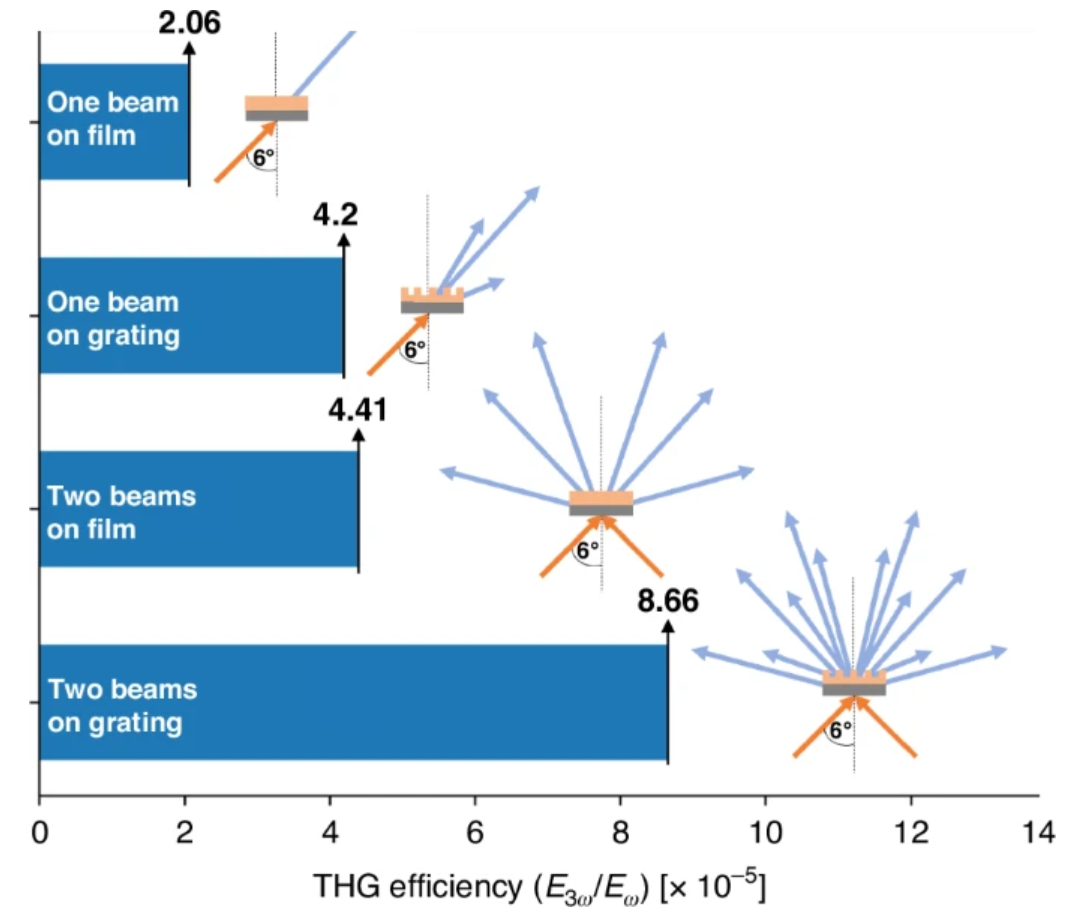
研究组通过将物理图案化的空间调制与由干涉超快脉冲诱导的正交时间晶格集成在一起,并利用在其低折射率窗口内工作的高非线性透明导电薄膜,实现了一种二维时空元晶格。光泵浦经历的是均匀介质,而时空晶格则可通过内部产生的三次谐波信号或外部提供的探测波来探测。该瞬态晶格表现出与等效物理结构相当的衍射效率,并且可通过包括脉冲延迟、入射角和波长在内的广泛参数进行动态重构。研究组还通过相位掩模波前调制展示了系统的灵活性,突显了其在超快瞬态光刻以及动量和频率上的光子操控方面非凡的通用性。这种方法将器件设计从固定的制造约束转向辐射工程,为超快可重构光子学开辟了新途径。
附:英文原文
Title: Spatio-temporal photonic metalattice
Author: Stengel, Sven, Jaffray, Wallace, Ali, Farhan, Goksu Ozlu, Mustafa, Fruhling, Colton B., Vincenti, Maria Antonietta, De Ceglia, Domenico, Scalora, Michael, Boltasseva, Alexandra, Shalaev, Vladimir M., Di Falco, Andrea, Ferrera, Marcello
Issue&Volume: 2026-10-29
Abstract: When coherent light interacts with an ordered lattice with periodicity comparable to its wavelength, a diffraction pattern emerges. The same principle applies in crystallography, where X-rays are employed to reveal atomic structures. By asking ‘when’ the diffractive object exists, rather than ’where’, we implicitly introduce time as a design parameter, thus enabling the creation of spatio-temporal metalattices. The temporal modulation of optical properties complements the spatial one, enabling functionalities such as dynamic reconfigurability, nonreciprocal behavior, coherent amplification, and tailored spectral response. However, for these effects to be relevant an extreme temporal gradient of the refractive index is necessary. In the present work, we realize a two-dimensional spatio-temporal metalattice by integrating a physically patterned spatial modulation with an orthogonal temporal lattice induced by interfering ultrafast pulses, using highly nonlinear transparent conducting films operated within their low-index window. While the optical pumps experience a uniform medium, the spatio-temporal lattice can be probed by either an internally generated third harmonic signal, or an externally supplied probe wave. The transient lattice shows comparable diffraction efficiency to the equivalent physical structure and is also dynamically reconfigurable via a broad range of parameters, including the pulses delay, incidence angle, and wavelength. System flexibility is also demonstrated through phase-mask wavefront modulation, highlighting exceptional versatility for ultrafast transient lithography and photon manipulation in both momentum and frequency. This approach shifts device design from fixed fabrication constraints to radiation engineering, opening new pathways towards ultrafast reconfigurable photonics.
DOI: 10.1038/s41377-026-02452-w
Source: https://www.nature.com/articles/s41377-026-02452-w
Light: Science & Applications:《光:科学与应用》,创刊于2012年。隶属于施普林格·自然出版集团,最新IF:19.4
官方网址:https://www.nature.com/lsa/
投稿链接:https://mts-lsa.nature.com/cgi-bin/main.plex