
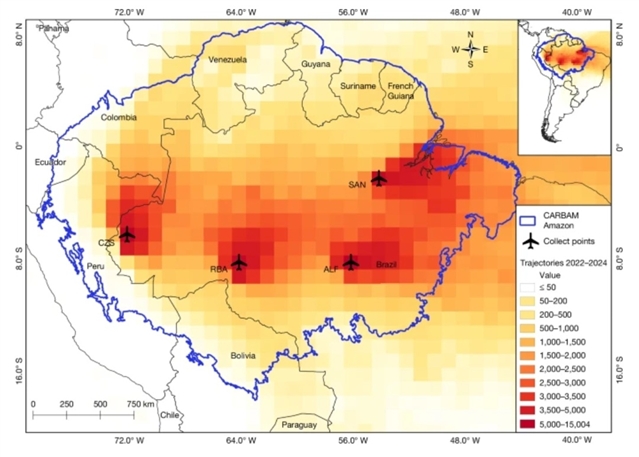
近日,巴西圣保罗国家空间研究所Luciana V. Gatti团队报道了由人类活动驱动、因干旱而放大的亚马孙碳排放。这一研究成果于2026年10月21日发表在《自然》杂志上。
亚马孙碳汇正在减弱,因为森林砍伐、树木死亡率上升和气候变化破坏了维持湿润热带森林的气候条件。森林丧失减少降水、升高温度并延长旱季,从而推动更高的碳排放。气候胁迫在森林砍伐更严重的地区更强,使森林逐渐变得更易燃。厄尔尼诺等大规模气候事件进一步放大区域气候影响。
研究组分析了15年来自大气CO2测量的亚马孙碳通量,确定碳平衡为0.32 ± 0.08 PgC yr-1,其中火灾是主要来源(0.40 ± 0.07 PgC yr-1),而森林吸收越来越无法抵消排放。此外,还研究了亚马孙碳排放的关键驱动因素,并识别出三个不同的年份组。
第1组(2011–2014年、2017年和2018年)代表在人类活动(如森林砍伐、生物质燃烧和退化)较低的较湿润年份中,亚马孙在全球碳平衡中的作用(0.11 ± 0.08 PgC yr-1)。第2组(2019–2022年)代表在气候胁迫较低的年份中,人类活动(主要是森林砍伐和退化)造成的亚马孙碳排放(0.43 ± 0.13 PgC yr-1)。第3组(2010年、2015年、2016年、2023年和2024年)碳排放最高(0.49 ± 0.07 PgC yr-1),包括温暖干燥年份(高气候胁迫),如厄尔尼诺和热带北大西洋变暖,并与生物质燃烧相关。
附:英文原文
Title: Amazon carbon emissions driven by human actions amplified by droughts
Author: Gatti, Luciana V., Cunha, Camilla L., Blas, Juan C. G., Denning, A. Scott, Reis, Mariane S., Marani, Luciano, Arai, Egidio, Messias, Cassiano Gustavo, Conciani, Dhemerson E., Miller, John B., Schumacher, Vancia, Naccarato, Kleber P., Marengo, Jose, Alencar, Ane A. C., Soler, Luciana, Almeida, Claudio, Domingues, Lucas Gatti, Correia, Caio S. C., Neves, Raiane A. L., Nobre, Carlos, Corra, Sergio M., Campbell, Elliott, Johnson, Jennifer E., Berry, Joseph A., Sanchez, Alber H., da Silva, Francine M., Camilotti, Vagner L., Silvestrini, Christiane, Lopes, Filipe Loyola, Lan, Xin, Ptron, Gabrielle, Malacarne, Marcio, Machado, Guilherme B. M.
Issue&Volume: 2026-10-21
Abstract: The Amazon carbon sink is weakening as deforestation1,2,3,4,5, rising tree mortality6,7,8 and climate change disrupt the climatic conditions that sustain a humid tropical forest9,10,11. Forest loss reduces precipitation, increases temperatures and lengthens the dry season, driving higher carbon emissions1,2,3,4,11,12. Climate stress is stronger in more deforested regions, rendering forests progressively more flammable1,9,13. Large-scale climate events, such as El Nio, further amplify regional climate impacts9,14,15,16,17. Here we present an analysis of 15years of Amazonian carbon fluxes derived from atmospheric CO2 measurements. We determine a carbon balance of 0.32±0.08PgCyr1, with fires acting as the dominant source (0.40±0.07PgCyr1) and forest uptake becoming increasingly unable to offset emissions. Furthermore, we investigate key drivers of the carbon emissions of Amazonia and identify three distinct year groups. Group 1 (2011–2014, 2017 and 2018) represents the role of the Amazon in the global carbon balance (0.11±0.08PgCyr1) during wetter years with low human activity, such as deforestation, biomass burning and degradation. Group 2 (2019–2022) represents Amazon carbon emissions (0.43±0.13PgCyr1) from human activities (mainly deforestation and degradation) during years with low climatic stress. Group 3 (2010, 2015, 2016, 2023 and 2024) has the highest carbon emissions (0.49±0.07PgCyr1) and comprises warm and dry years (high climate stress), such as El Nio and the warming of the Tropical North Atlantic Ocean, associated with biomass burning.
DOI: 10.1038/s41586-026-11168-1
Source: https://www.nature.com/articles/s41586-026-11168-1
Nature:《自然》,创刊于1869年。隶属于施普林格·自然出版集团,最新IF:69.504
官方网址:http://www.nature.com/
投稿链接:http://www.nature.com/authors/submit_manuscript.html