
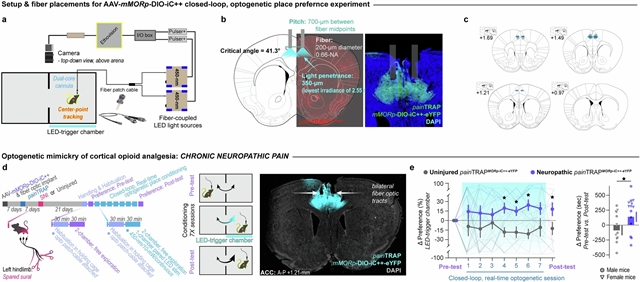
宾夕法尼亚大学Gregory Corder团队宣布他们揭示了皮质疼痛回路中阿片镇痛的模拟。2026年1月7日,国际知名学术期刊《自然》发表了这一成果。
在这里,该团队展示了一群扣带神经元编码自发的与疼痛相关的行为,并被吗啡选择性地调节。通过结合小鼠纵向神经记录的深度学习行为分析,课题组确定了神经损伤后皮层活动模式的持续变化,这反映了不愉快的情感慢性疼痛状态的出现。吗啡逆转了这些神经性神经动力学,在不改变感觉探测或反射反应的情况下减少了情感动机行为,反映了阿片类药物如何减轻人类的疼痛和不愉快。
利用这些发现,研究团队建立了一种受生物学启发的化学发生基因疗法,该疗法针对扣带中的阿片敏感神经元,通过合成μ-阿片受体启动子来驱动抑制。这种模拟阿片类药物的化学发生基因疗法再现了吗啡在慢性神经性疼痛中的镇痛作用,从而为精确疼痛管理提供了一种新的策略,该策略针对关键的伤害性皮质阿片回路,提供安全的、按需镇痛。
研究人员表示,前扣带皮层是参与疼痛的情感和动机维度的关键脑区,但阿片类镇痛药如何调节这一皮质回路仍不清楚。揭示阿片类药物如何改变伤害性神经动力学以产生疼痛缓解对于开发更安全和更有针对性的慢性疼痛治疗至关重要。
附:英文原文
Title: Mimicking opioid analgesia in cortical pain circuits
Author: Oswell, Corinna S., Rogers, Sophie A., James, Justin G., McCall, Nora M., Hsu, Alex I., Salimando, Gregory J., Mahmood, Malaika, Wooldridge, Lisa M., Wachira, Meghan, Jo, Adrienne Y., Sandoval Ortega, Raquel Adaia, Wojick, Jessica A., Beattie, Katherine, Farinas, Sofia A., Chehimi, Samar N., Rodrigues, Amrith, Wu, Jacqueline W. K., Ejoh, Lindsay L., Kimmey, Blake A., Lo, Emily, Azouz, Ghalia, Vasquez, Jose J., Banghart, Matthew R., Beier, Kevin T., Creasy, Kate Townsend, Crist, Richard C., Ramakrishnan, Charu, Reiner, Benjamin C., Deisseroth, Karl, Yttri, Eric A., Corder, Gregory
Issue&Volume: 2026-01-07
Abstract: The anterior cingulate cortex is a key brain region involved in the affective and motivational dimensions of pain, but how opioid analgesics modulate this cortical circuit remains unclear1. Uncovering how opioids alter nociceptive neural dynamics to produce pain relief is essential for developing safer and more targeted treatments for chronic pain. Here we show that a population of cingulate neurons encodes spontaneous pain-related behaviours and is selectively modulated by morphine. Using deep learning behavioural analyses combined with longitudinal neural recordings in mice, we identified a persistent shift in cortical activity patterns following nerve injury that reflects the emergence of an unpleasant, affective chronic pain state. Morphine reversed these neuropathic neural dynamics and reduced affective–motivational behaviours without altering sensory detection or reflexive responses, mirroring how opioids alleviate pain unpleasantness in humans. Leveraging these findings, we built a biologically inspired chemogenetic gene therapy that targets opioid-sensitive neurons in the cingulate using a synthetic μ-opioid receptor promoter to drive inhibition2. This opioid-mimetic chemogenetic gene therapy recapitulated the analgesic effects of morphine during chronic neuropathic pain, thereby offering a new strategy for precision pain management that targets a key nociceptive cortical opioid circuit with safe, on-demand analgesia.
DOI: 10.1038/s41586-025-09908-w
Source: https://www.nature.com/articles/s41586-025-09908-w
Nature:《自然》,创刊于1869年。隶属于施普林格·自然出版集团,最新IF:69.504
官方网址:http://www.nature.com/
投稿链接:http://www.nature.com/authors/submit_manuscript.html