
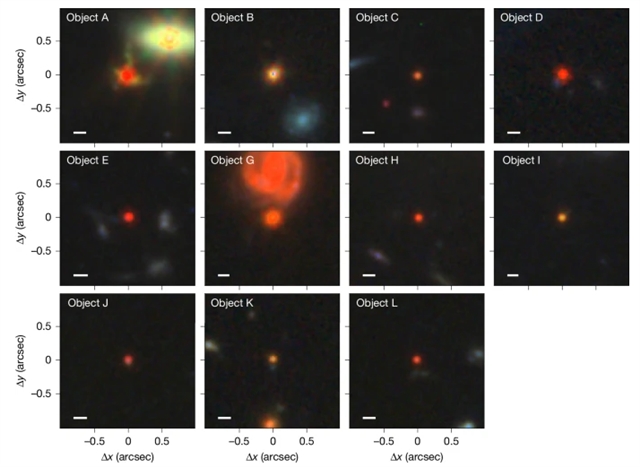
近日,英国曼彻斯特大学V. Rusakov团队报道了神秘“小红点”是处于密集电离茧中的年轻超大质量黑洞。2026年1月14日,《自然》杂志发表了这一成果。
詹姆斯·韦伯空间望远镜(JWST)在高红移星系中发现诸多具有宽氢氦发射线的致密星系,其中包括一类神秘的“小红点”天体。关于这些星系本质的争论集中于其源自超大质量黑洞还是剧烈恒星形成活动。若归因于超大质量黑洞,它们则展现出若干异常特性,例如黑洞质量相对宿主星系显著超重,且X射线与射电辐射极度微弱。
研究组通过对JWST最高质量光谱数据的分析表明,大多数目标天体中的谱线展宽主要由电子散射导致,其内禀谱线核心实际狭窄。数据要求极高的电子柱密度与极小的空间尺度(光日量级),结合其高光度特征,仅能通过超大质量黑洞吸积模型加以解释。狭窄的内禀谱线核心暗示黑洞质量约为105-107太阳质量,较先前估算低两个数量级。
据研究组所知,这是目前已知高红移条件下质量最小的黑洞群体,可能代表一类年轻的超大质量黑洞。这些黑洞被包裹在致密的电离气体茧中,产生宽发射线,其吸积率接近爱丁顿极限,仅伴随微弱的中性外流。该气体茧产生的再处理星云辐射主导了光学波段光谱,从而解释了“小红点”多数光谱特征(包括微弱的射电与X射线辐射)的形成机制。
附:英文原文
Title: Little red dots as young supermassive black holes in dense ionized cocoons
Author: Rusakov, V., Watson, D., Nikopoulos, G. P., Brammer, G., Gottumukkala, R., Harvey, T., Heintz, K. E., Damgaard, R., Sim, S. A., Sneppen, A., Vijayan, A. P., Adams, N., Austin, D., Conselice, C. J., Goolsby, C. M., Toft, S., Witstok, J.
Issue&Volume: 2026-01-14
Abstract: The James Webb Space Telescope (JWST) has uncovered many compact galaxies at high redshift with broad hydrogen and helium lines, including the enigmatic population of little red dots (LRDs)1,2. The nature of these galaxies is debated and is attributed to supermassive black holes (SMBHs)3,4 or intense star formation5. They exhibit unusual properties for SMBHs, such as black holes that are overmassive for their host galaxies4 and extremely weak X-ray6,7,8,9,10 and radio6,11,12,13 emission. Here we show that in most objects studied with the highest-quality JWST spectra, the lines are broadened by electron scattering with a narrow intrinsic core. The data require very high electron column densities and compact sizes (light days), which, when coupled with their high luminosities, can be explained only by SMBH accretion. The narrow intrinsic line cores imply black hole masses of 1057M⊙, two orders of magnitude lower than previous estimates. These are the lowest mass black holes known at high redshift, to our knowledge, and suggest a population of young SMBHs. They are enshrouded in a dense cocoon of ionized gas producing broad lines from which they are accreting close to the Eddington limit, with very mild neutral outflows. Reprocessed nebular emission from this cocoon dominates the optical spectrum, explaining most LRD spectral characteristics, including the weak radio and X-ray emission14,15.
DOI: 10.1038/s41586-025-09900-4
Source: https://www.nature.com/articles/s41586-025-09900-4
Nature:《自然》,创刊于1869年。隶属于施普林格·自然出版集团,最新IF:69.504
官方网址:http://www.nature.com/
投稿链接:http://www.nature.com/authors/submit_manuscript.html