
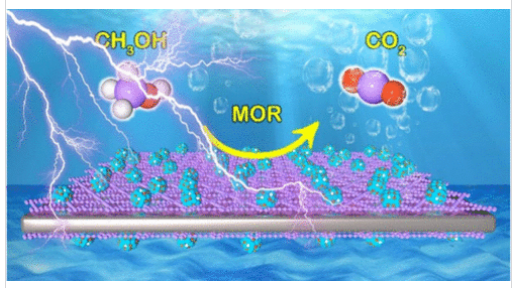
近日,中国科学院化学所李玉良团队研究了用于甲醇氧化反应的自修复铂催化剂。相关论文于2026年1月13日发表在《美国化学会志》上。
自修复催化剂对于实现电化学反应的催化稳定性至关重要。然而,如何设计不依赖外部干预即可实现最优性能的自修复结构仍面临极大挑战。
研究组设计了一种由氧空位和活性氧组成的自修复铂催化剂,旨在实现不同的甲醇氧化路径及高性能碱性甲醇氧化反应。该催化剂对甲醇氧化反应表现出8.8 A mgPt-1的优异质量活性,比商业Pt/C催化剂提升了一个数量级。在150 mA cm-2的高电流密度下持续运行300小时后,其电流密度仍无衰减,展现出卓越的耐久性。原位X射线吸收光谱揭示了电极充电状态下,铂活性位点从水合结构到重构态的结构演化。
通过原位拉曼光谱与原位傅里叶变换红外光谱追踪关键反应中间体,确定了在运行条件下催化剂通过特定活性位点实现无CO毒化的反应路径。原位微分电化学质谱结合理论计算表明,该催化剂可为甲醇电氧化提供活性氧并产生氧空位,同时通过OH*在氧空位上的填充与脱质子过程,清晰地展示了活性氧的自修复机制。这些发现揭示了自修复催化剂在实现电化学甲醇氧化反应高活性与高稳定性中的关键作用。
附:英文原文
Title: A Self-Healing Platinum Catalyst for Methanol Oxidation Reaction
Author: Xueting Zhang, Lan Hui, Zhaozhong Wang, Chenxuan Liu, Yinfei Yang, Yuliang Li
Issue&Volume: January 13, 2026
Abstract: Self-healing catalysts are crucial for achieving the catalytic stability of the electrochemical reactions. However, designing self-healing structures is essential for optimal catalysts without relying on external interventions, but it remains extremely challenging. Here a self-healing platinum catalyst composed of oxygen vacancy (VO) and active oxygen (GDY/VO-PtOx Cc) is designed to realize different methanol oxidation routes and high-performance alkaline methanol oxidation reactions (MOR). The resulting catalyst displays excellent mass activity of 8.8 A mgPt–1 for MOR, 1 order of magnitude higher than the commercial Pt/C. The catalyst also demonstrates robust durability with no current density loss even after 300 h at a high current density of 150 mA cm–2. In situ X-ray absorption spectroscopy reveals a reconstruction in the active structure of Pt sites from its hydrated state on a charged electrode. In situ Raman and in situ FTIR measurements on the catalyst to track the critical intermediates and unveil specific active sites to identify a CO-poisoning-free reaction route under operating conditions. In situ differential electrochemical mass spectrometry (DEMS) results coupled with theoretical calculations reveal that the catalyst provides active oxygen for methanol electrooxidation and produces an oxygen vacancy, and clearly showing the self-healing of active oxygen through OH* filling and deprotonation on the oxygen vacancy. These findings show the pivotal role of self-healing catalysts for achieving high activity and stability during the electrochemical MOR.
DOI: 10.1021/jacs.5c14625
Source: https://pubs.acs.org/doi/abs/10.1021/jacs.5c14625
JACS:《美国化学会志》,创刊于1879年。隶属于美国化学会,最新IF:16.383
官方网址:https://pubs.acs.org/journal/jacsat
投稿链接:https://acsparagonplus.acs.org/psweb/loginForm?code=1000