
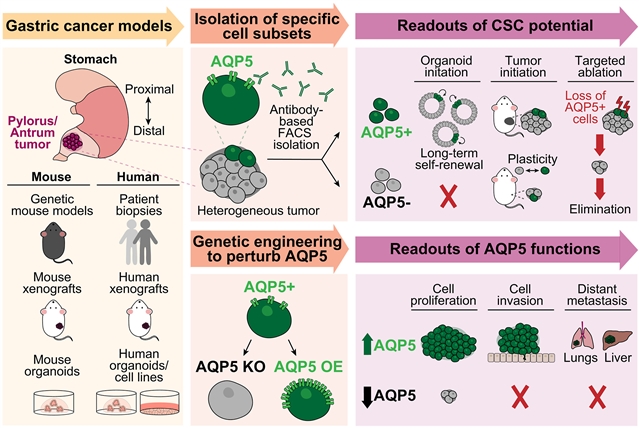
在本研究中,该课题组人员建立了一个以水通道蛋白aquaporin-5(AQP5)为标记的胃CSC群体,该群体存在于人和母主题幽门肿瘤中。通过多种类器官和小鼠模型,研究组发现AQP5+ CSCs在启动和维持癌症进展中都是必需的,并证明AQP5的表达也以WNT、PI3K(磷脂酰肌醇3-激酶)和MAPK(丝裂原活化蛋白激酶)依赖的方式直接促进肿瘤的生长和侵袭。除了原发癌症,AQP5在转移性肿瘤中进一步表达功能性CSC群体。总之,他们的发现支持胃肿瘤中的CSC模型,该模型可能适用于针对CSC的治疗策略。
研究人员表示,癌症干细胞(CSCs)是一种自我更新的细胞群,能够促进肿瘤的长期生长。在胃癌中,CSC群体的身份尚不清楚。
附:英文原文
Title: AQP5: A functional gastric cancer stem cell marker in mouse and human tumors
Author: Hui Yi Grace Lim, Swathi Yada, Kazuhiro Murakami, Bernett Teck Kwong Lee, Sowmya Sagiraju, Phyllis Phuah, Tanysha Chi-Ying Chen, Fidelia B. Alvina, Si Hui Tan, Kaushal Krishna Kaslikar, Nur Syahirah Binte Ruhazat, Menaka Priyadharsani Rajapakse, Katzrin Bte Ahmad Murad, Snezhina Kancheva, Liang Thing Tan, Seri Mustafah, Jimmy Bok Yan So, Nick Barker
Issue&Volume: 2025-12-18
Abstract: Cancer stem cells (CSCs) represent a self-renewing population capable of fueling long-term tumor growth. In gastric cancer, the identity of CSC populations remains unclear. In this study, we established a gastric CSC population marked by the water channel protein aquaporin-5 (AQP5), which resides in human and mouse pyloric tumors. Using multiple organoid and mouse models, we found a requirement for AQP5+ CSCs in both initiating and sustaining cancer progression and demonstrated that AQP5 expression also directly promotes tumor growth and invasion in a WNT, PI3K (phosphatidylinositol 3-kinase), and MAPK (mitogen-activated protein kinase)–dependent manner. Beyond primary cancers, AQP5 further enriches for a functional CSC population in metastatic tumors. Together, our findings support a CSC model in gastric tumors that may have application for therapeutic strategies targeting CSCs.
DOI: adr2428
Source: https://www.science.org/doi/10.1126/science.adr2428