
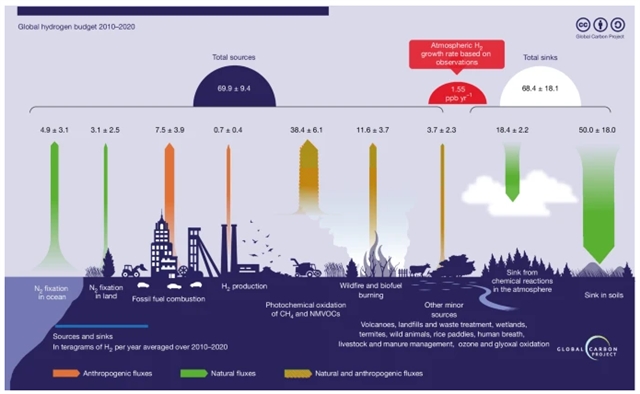
近日,美国斯坦福大学Robert B. Jackson团队研究了全球氢预算。相关论文于2025年12月17日发表在《自然》杂志上。
氢(H2)将在全球能源系统脱碳过程中发挥重要作用。然而,氢气与甲烷、臭氧及平流层水蒸气相互作用,产生的间接百年全球变暖潜能值为11±4。这引发了对未来氢经济体系下增加氢使用可能带来的气候影响的担忧。全面核算氢的来源与去向,对于评估其变化及缓解环境风险至关重要。
研究组分析了1990年至2020年全球氢源汇变化趋势,并构建了2010-2020十年间的完整收支平衡。在此期间,氢源持续增长,主要源于甲烷与人为非甲烷挥发性有机化合物的氧化、生物固氮作用以及制氢过程中的泄漏。随着大气中氢气浓度上升,其汇也随之增加。2010-2020年间,全球氢源与氢汇的年均值分别为69.9±9.4太克/年与68.4±18.1太克/年。
区域分析显示,非洲与南美洲是最大的氢源与氢汇分布区,而东亚与北美则贡献了化石燃料燃烧产生的最多氢气排放。研究组估算,2010至2020年间大气氢浓度上升导致全球地表气温(GSAT)升高0.02±0.006°C。根据未来典型共享社会经济路径情景预测,大气氢浓度变化对GSAT的影响将保持在0.01-0.05°C范围内,具体取决于氢使用量、泄漏率以及影响光化学产氢过程的甲烷排放量。
附:英文原文
Title: The global hydrogen budget
Author: Ouyang, Zutao, Jackson, Robert B., Saunois, Marielle, Canadell, Josep G., Zhao, Yuanhong, Morfopoulos, Catherine, Krummel, Paul B., Patra, Prabir K., Peters, Glen P., Dennison, Fraser, Gasser, Thomas, Archibald, Alexander T., Arora, Vivek, Baudoin, Gabriel, Chandra, Naveen, Ciais, Philippe, Davis, Steven J., Feron, Sarah, Guo, Fangzhou, Hauglustaine, Didier, Jones, Christopher D., Jones, Matthew W., Kato, Etsushi, Kennedy, Daniel, Knauer, Jrgen, Lienert, Sebastian, Lombardozzi, Danica, Melton, Joe R., Nabel, Julia E.M.S., OSullivan, Michael, Ptron, Gabrielle, Poulter, Benjamin, Rogelj, Joeri, Sandoval Calle, David, Smith, Pete, Suntharalingam, Parvadha, Tian, Hanqin, Wang, Chenghao, Wiltshire, Andy
Issue&Volume: 2025-12-17
Abstract: Hydrogen (H2) will play a part in decarbonizing the global energy system1. However, hydrogen interacts with methane, ozone, and stratospheric water vapour, leading to an indirect 100-year global warming potential of 11±4 (refs.2,3,4,5). This raises concerns about the climate consequences of increasing H2 use under future hydrogen economies3,5. A comprehensive accounting of H2 sources and sinks is essential for assessing changes and mitigating environmental risks. Here we analyse trends in global H2 sources and sinks from 1990 to 2020 and construct a comprehensive budget for the decade 2010–2020. H2 sources increased from 1990 to 2020, primarily because of the oxidation of methane and anthropogenic non-methane volatile organic compounds, biogenic nitrogen fixation, and leakage from H2 production. Sinks also increased in response to rising atmospheric H2. Estimated global H2 sources and sinks averaged 69.9±9.4Tgyr1 and 68.4±18.1Tgyr1, respectively, for 2010–2020. Regionally, Africa and South America contained the largest sources and sinks of H2, whereas East Asia and North America contributed the most H2 emissions from fossil fuel combustion. We estimate that rising atmospheric H2 between 2010 and 2020 contributed to an increase in global surface air temperature (GSAT) of 0.02±0.006°C. GSAT impacts of changing atmospheric H2 in future marker Shared Socioeconomic Pathway scenarios are estimated to remain within 0.01–0.05°C, depending on H2 usage, leakage rates and CH4 emissions that influence photochemical H2 production.
DOI: 10.1038/s41586-025-09806-1
Source: https://www.nature.com/articles/s41586-025-09806-1
Nature:《自然》,创刊于1869年。隶属于施普林格·自然出版集团,最新IF:69.504
官方网址:http://www.nature.com/
投稿链接:http://www.nature.com/authors/submit_manuscript.html