
2025年12月15日出版的《自然—神经科学》杂志发表了德国科学家的一项最新成果。来自慕尼黑大学的Martin Dichgans小组的研究发现卒中风险基因Foxf2通过Tie2信号传导维持脑内皮细胞功能。
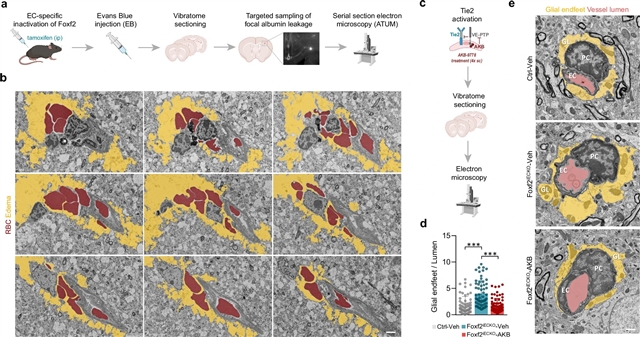
研究小组发现Foxf2通过Tie2信号传导维持EC功能。RNA和染色质测序鉴定FOXF2是Tie2和其他内皮细胞谱系特异性基因的转录激活因子。成年小鼠EC特异性Foxf2的缺失导致血脑屏障渗漏,并在实验性脑卒中后恶化。对缺乏FOXF2的多主题脑源性和人诱导多能干细胞源性ECs的蛋白质组学分析显示,参与Tie2信号传导的多种蛋白下调。内皮Foxf2缺陷通过破坏Tie2信号导致功能性充血、一氧化氮生成减少和梗死面积增加,这些效应通过AKB-9778对Tie2的药理激活得以恢复。总的来说,他们的结果强调了Foxf2调节的Tie2信号在SVD和卒中中的关键作用,为治疗干预提供了新的途径。
据了解,脑血管病(SVD)是一种常见的慢性脑血管疾病,其发病机制尚不清楚。遗传学研究已经确定FOXF2是SVD和中风的主要风险基因。FOXF2编码一种主要表达于脑周细胞和内皮细胞(ECs)的转录因子;然而,其在脑血管疾病中的机制作用尚不清楚。
附:英文原文
Title: The stroke risk gene Foxf2 maintains brain endothelial cell function via Tie2 signaling
Author: Todorov-Vlgyi, Katalin, Gonzlez-Gallego, Judit, Mller, Stephan A., Todorov, Mihail Ivilinov, Seker, Fatma Burcu, Frerich, Simon, Cernilogar, Filippo M., Schrger, Luise, Malik, Rainer, Cao, Jiayu, Llovera, Gemma, Roth, Stefan, Schillinger, Ulrike, Schifferer, Martina, Reyahi, Azadeh, Crusius, Dennis, Pedro, Liliana D., Simons, Mikael, Carlsson, Peter, Ertrk, Ali, Liesz, Arthur, Schotta, Gunnar, Plesnila, Nikolaus, Lichtenthaler, Stefan F., Paquet, Dominik, Dichgans, Martin
Issue&Volume: 2025-12-15
Abstract: Cerebral small vessel disease (SVD) is a common chronic cerebrovascular disorder with poorly understood pathomechanisms. Genetic studies have identified FOXF2 as a major risk gene for both SVD and stroke. FOXF2 encodes a transcription factor primarily expressed in brain pericytes and endothelial cells (ECs); however, its mechanistic role in cerebrovascular disease remains unknown. Here we show that Foxf2 maintains EC function through Tie2 signaling. RNA and chromatin sequencing identified FOXF2 as a transcriptional activator of Tie2 and other endothelial lineage-specific genes. The deletion of EC-specific Foxf2 in adult mice resulted in blood–brain barrier leakage, which worsened after experimental stroke. Proteomic analyses of Foxf2-deficient mouse brain-derived and human-induced pluripotent stem cell-derived ECs that lack FOXF2 revealed a downregulation of multiple proteins involved in Tie2 signaling. Endothelial Foxf2 deficiency impaired functional hyperemia, reduced NO production and increased infarct size through disrupted Tie2 signaling, effects that were rescued by pharmacological activation of Tie2 with AKB-9778. Collectively, our results highlight the critical role of Foxf2-regulated Tie2 signaling in SVD and stroke, suggesting new avenues for therapeutic interventions.
DOI: 10.1038/s41593-025-02136-5
Source: https://www.nature.com/articles/s41593-025-02136-5
Nature Neuroscience:《自然—神经科学》,创刊于1998年。隶属于施普林格·自然出版集团,最新IF:28.771
官方网址:https://www.nature.com/neuro/
投稿链接:https://mts-nn.nature.com/cgi-bin/main.plex