
近日,华东理工大学龚岩团队研究了带流气化过程中水煤浆颗粒反应特性的数值模拟。这一研究成果于2025年11月26日发表在《颗粒学报》杂志上。
气化技术是现代煤化工的基石。气流床气化炉内的高温颗粒作为核心反应介质,其反应活性本质上取决于颗粒尺寸、孔隙结构及局部反应环境。当前对气化炉内颗粒的实验研究主要依赖可视化系统,但在精确颗粒追踪与定量分析方面仍面临严峻挑战,尤其在挥发分释放过程的诊断上。
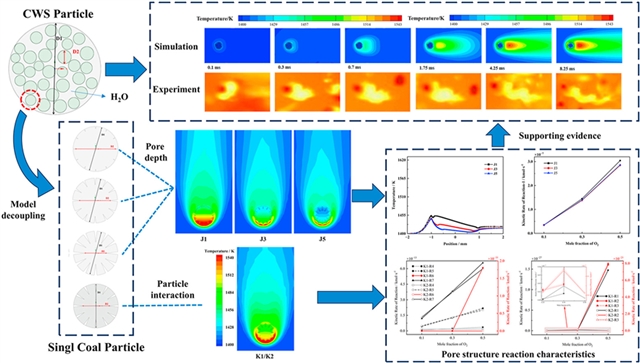
研究组采用计算流体力学(CFD)数值模拟方法,构建了多相流模型,旨在从水煤浆(CWS)的燃烧-气化耦合过程中解析单颗粒独立行为。通过建立不同构型的离散煤颗粒模型,对比分析了孤立颗粒与相互作用颗粒的反应特性,并系统考察了三种孔隙率条件下的温度场与反应速率分布。验证结果表明,所建模型能准确描述煤颗粒的反应特征。研究发现:温度场分布与CWS颗粒挥发分摩尔分数呈强相关性,在颗粒核心区观察到H2、H2O和CO的富集现象;颗粒间的传热传质耦合效应通过调控颗粒间距与传热/传质效率,显著影响反应速率与温度场分布,而孔隙率的影响相对较弱。
附:英文原文
Title: Numerical simulation on the reaction characteristics of a coal-water slurry particle during entrained-flow gasification process
Author: Yan Gong, Bo Zhao, Wenjing Zhao, Xuning Wang, Qinghua Guo, Yifei Wang, Jin Bai, et al.
Issue&Volume: 2025/11/26
Abstract: Gasification technology serves as the cornerstone of the modern coal chemical industry. High-temperature particles in entrained-flow gasifiers act as the primary reaction medium, whose reactivity is inherently dependent on particle size, porosity, and local reaction environment. Current experimental investigations on particles within gasifiers predominantly rely on visualization systems, yet face significant challenges in precise particle tracking and quantitative analysis, particularly in diagnosing volatile release processes. This study employed computational fluid dynamics (CFD) numerical simulations to develop a multiphase model to isolate single particle behavior from bulk particle group during coupled combustion-gasification process of coal-water slurry (CWS). Discrete coal particle models with varying configurations were developed to compare reaction characteristics between isolated and interacting particles, while analyzing temperature fields and reaction rate distributions across three porosity levels. Verification demonstrated that the implemented models effectively described the reaction characteristics of coal particles. Results reveal strong correlation between the temperature field distribution and the volatile molar fraction in CWS particle, with H2, H2O, and CO accumulation observed at particle cores. Coupling effects of heat and mass transfer between particles significantly influence reaction rates and thermal profiles, governed by the particle spacing and heat/mass transfer efficiency, whereas the effects of porosity remain relatively minor.
DOI: 10.1016/j.partic.2025.11.012
Source: https://www.sciencedirect.com/science/article/abs/pii/S1674200125003153
Particuology:《颗粒学报》,创刊于2003年。隶属于爱思唯尔出版集团,最新IF:3.5
官方网址:https://www.sciencedirect.com/journal/particuology
投稿链接:https://www2.cloud.editorialmanager.com/partic/default2.aspx