
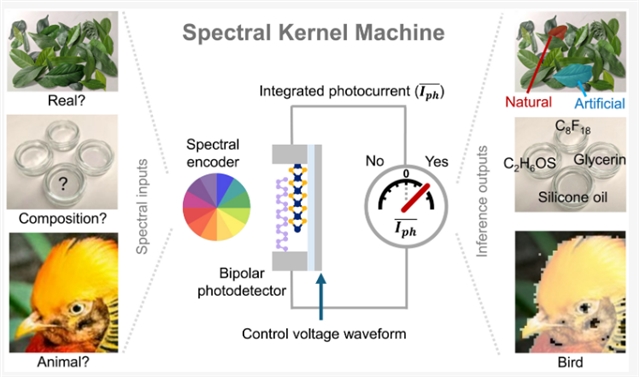
光谱机器视觉通过采集光谱与空间信息形成的三维超立方体进行数字处理,导致数据瓶颈,限制了功耗效率、帧率和光谱-空间分辨率。
研究组引入光谱核机(SKMs)突破这些瓶颈。SKM通过输出光电流直接压缩光谱分析,并通过示例对象学习,在“嗅探-搜索”模式下识别并分类新样本。实验采用近/中红外波段的电可调双极性黑磷-二硫化钼(bP-MoS2)光电二极管和可见波段的硅光电导体,展示了SKMs在化学计量学到半导体计量学等多样化智能任务中的应用。该架构比现有高光谱图像分析方案功耗显著降低,且速度提高一个数量级以上,定义了一种具有吸引力的智能成像与感知范式。
附:英文原文
Title: Spectral kernel machines with electrically tunable photodetectors
Author: Dehui Zhang, Yuhang Li, Jamie Geng, Hyong Min Kim, Marco Ma, Shifan Wang, Inha Kim, Theodorus Jonathan Wijaya, Naoki Higashitarumizu, I. K. M. Reaz Rahman, Dorottya Urmossy, James Bullock, Aydogan Ozcan, Ali Javey
Issue&Volume: 2025-11-27
Abstract: Spectral machine vision collects spectral and spatial information as three-dimensional hypercubes and digitally processes them, which causes a data bottleneck, limiting power efficiency, frame rate, and spectral-spatial resolution. This work introduces spectral kernel machines (SKMs) to overcome these bottlenecks. SKM directly compresses spectral analysis through the output photocurrent and learns from example objects to identify and classify new samples in a “sniff-and-seek” mode. We experimentally demonstrated SKMs with electrically tunable bipolar black phosphorus–molybdenum disulfide (bP-MoS2) photodiodes in the near- and mid-infrared band and silicon photoconductors in the visible band, performing versatile intelligent tasks from chemometrics to semiconductor metrology. This architecture consumed substantially less power and was more than an order of magnitude faster than existing solutions for hyperspectral image analysis, defining an intelligent imaging and sensing paradigm with intriguing possibilities.
DOI: ady6571
Source: https://www.science.org/doi/10.1126/science.ady6571