
近日,英国赫瑞瓦特大学Mehul Malik团队研究了大规模可重构多路量子光子网络。相关论文发表在2025年11月26日出版的《自然—光子学》杂志上。
量子网络中纠缠的分发将推动量子保密通信、分布式量子计算和传感等新一代技术的发展。未来的量子网络需要高密度的连接能力,允许多个用户以可重构和多路复用的方式共享纠缠,而远距离连接则通过纠缠隐形传态或纠缠交换实现。尽管近期研究已展示基于多路复用的全连接本地多用户网络,但将此类网络扩展为互联局部网络组成的全球架构仍是一项重大挑战。
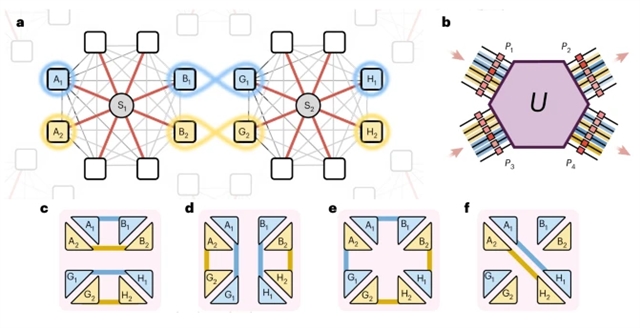
研究组实现了多路复用量子网络演化的关键一步——一个原型全球可重构网络,可在两个本地四用户网络间以灵活且多路复用的方式路由和隐形传态纠缠。该网络的核心是一个可编程的8×8维多端口电路,利用多模光纤内部的自然模混合过程,对携带八个横模的两个独立光子执行按需高维操作。该电路设计使研究组摆脱了传统集成光子平台受限的平面几何结构,规避了其控制和制造难题。本演示突显了该架构在构建大规模全球量子网络中的潜力,既能提供灵活的互联性,又与现有通信基础设施完全兼容。
附:英文原文
Title: A large-scale reconfigurable multiplexed quantum photonic network
Author: Valencia, Natalia Herrera, Ma, Annameng, Goel, Suraj, Leedumrongwatthanakun, Saroch, Graffitti, Francesco, Fedrizzi, Alessandro, McCutcheon, Will, Malik, Mehul
Issue&Volume: 2025-11-26
Abstract: The distribution of entanglement in quantum networks will enable the next generation of technologies in quantum-secured communications, distributed quantum computing and sensing. Future quantum networks will require dense connectivity, allowing multiple users to share entanglement in a reconfigurable and multiplexed manner, while long-distance connections are established through the teleportation of entanglement, or entanglement swapping. Although several recent works have demonstrated fully connected, local multi-user networks based on multiplexing, extending such networks to a global network architecture of interconnected local networks remains an outstanding challenge. Here we demonstrate the next step in the evolution of multiplexed quantum networks—a prototype global reconfigurable network in which entanglement is routed and teleported in a flexible and multiplexed manner between two local four-user networks. At the heart of our network is a programmable 8×8-dimensional multi-port circuit that harnesses the natural mode-mixing process inside of a multi-mode fibre to implement on-demand high-dimensional operations on two independent photons carrying eight transverse-spatial modes. Our circuit design allows us to break away from the limited planar geometry and bypass the control and fabrication challenges of conventional integrated photonic platforms. Our demonstration highlights the potential of this architecture for enabling large-scale, global quantum networks that offer versatile connectivity while being fully compatible with an existing communications infrastructure.
DOI: 10.1038/s41566-025-01806-x
Source: https://www.nature.com/articles/s41566-025-01806-x