
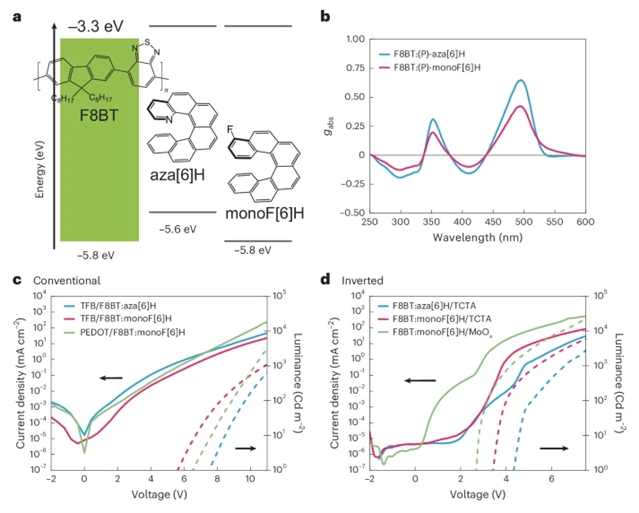
近日,英国帝国理工学院Matthew J. Fuchter团队报道了有机电致发光材料中光子自旋角动量的电控制。2025年11月26日出版的《自然—光子学》杂志发表了这项成果。
圆偏振光(CP)中编码的光子自旋信息对当前及未来技术(如低功耗显示、加密通信及高性能量子应用)具有重要价值。制备能发射相反手性电致发光圆偏振光的有机发光二极管(LED)通常需要使用左旋与右旋手性分子。在共轭聚合物LED中,圆偏振电致发光的手性还取决于活性层厚度或电流方向。对于固定活性层厚度的器件,是否可通过单一手性材料在同一LED结构中实现圆偏振光手性的反转仍未知。
研究组展示了仅通过特定中间层即可电学调控有机LED发射的圆偏振电致发光手性,无需改变发光材料组分或厚度。他们发现,这种调控源于器件内部复合区位置变化导致的圆偏振电致发光产生机制改变。该结果为实现可控自旋角动量信息的有机圆偏振LED提供了范式转变,并为手性光电子学的基础物理研究提供了新视角。
附:英文原文
Title: Electrical control of photon spin angular momentum in organic electroluminescent materials
Author: Furlan, Francesco, mal, Michal, Rybek, Ji, Taddeucci, Andrea, Di Girolamo, Marta, Nodari, Davide, Siligardi, Giuliano, Wade, Jessica, Yan, Binghai, Star, Irena G., Gasparini, Nicola, Fuchter, Matthew J.
Issue&Volume: 2025-11-26
Abstract: The photon spin information encoded in circularly polarized (CP) light is of high interest for current and future technologies, including low-power displays, encrypted communications and high-performance quantum applications. Engineering organic light-emitting diodes (LED) to emit oppositely handed electroluminescent CP light typically requires access to left- and right-handed chiral molecules. In conjugated polymer LEDs, the handedness of CP electroluminescence also depends on the active-layer thickness or direction of current flow. For a given active-layer thickness, it remains unknown whether a single-handed chiral material can emit CP light with opposite handedness in the same LED architecture. Here we demonstrate organic LEDs in which the handedness of the emitted CP electroluminescence can be controlled electrically, solely by using specific interlayers with no change in the emissive material composition or thickness. We reveal that this occurs due to a change in mechanism for the generation of CP electroluminescence, as a function of the recombination zone position within the device. This result provides a paradigm shift in the realization of organic CP-LEDs with controllable spin angular momentum information and further contributes to ongoing discussions relating the fundamental physics of chiral optoelectronics. Electrical tuning of the recombination zone in circularly polarized (CP) OLEDs enables switching the CP generation mechanism between normal and anomalous CP electroluminescence. This is exploited to electrically control the handedness of emitted CP light from the same device with the same enantiomer material.
DOI: 10.1038/s41566-025-01780-4
Source: https://www.nature.com/articles/s41566-025-01780-4