
近日,德国柏林自由大学Jens Eisert团队研究了学习连续变量系统的量子态。该项研究成果发表在2025年11月26日出版的《自然—物理学》杂志上。
量子测量具有概率性,通常仅能提供量子态的不完全信息。要获得未知量子态的完整经典描述,需分析多种不同测量,这一过程称为量子态层析。
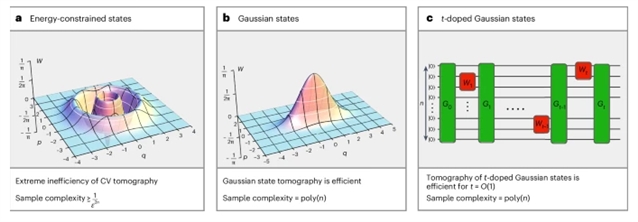
研究组分析了连续变量系统(如玻色子和量子光学系统)层析的极限性能。他们证明,此类系统的层析在时间资源上极其低效,远超有限维系统(如量子比特)。不仅实现层析所需的最小态拷贝数随模数呈指数增长,即使对于低能态,其与估计态的迹距离误差也随误差标度呈不利增长。值得肯定的是,研究组证明高斯态的层析是高效的:通过限定一阶和二阶矩的误差边界,可建立对高斯态估计误差的迹距离上界。最后,研究组验证了通过高斯幺正操作和少量局部非高斯演化制备的非高斯态层析是高效且实验可行的。
附:英文原文
Title: Learning quantum states of continuous-variable systems
Author: Mele, Francesco A., Mele, Antonio A., Bittel, Lennart, Eisert, Jens, Giovannetti, Vittorio, Lami, Ludovico, Leone, Lorenzo, Oliviero, Salvatore F. E.
Issue&Volume: 2025-11-26
Abstract: Quantum measurements are probabilistic and, in general, provide only partial information about the underlying quantum state. Obtaining a full classical description of an unknown quantum state requires the analysis of several different measurements, a task known as quantum-state tomography. Here we analyse the ultimate achievable performance in the tomography of continuous-variable systems, such as bosonic and quantum optical systems. We prove that tomography of these systems is extremely inefficient in terms of time resources, much more so than tomography of finite-dimensional systems such as qubits. Not only does the minimum number of state copies needed for tomography scale exponentially with the number of modes, but, even for low-energy states, it also scales unfavourably with the trace-distance error between the original state and its estimated classical description. On a more positive note, we prove that the tomography of Gaussian states is efficient by establishing a bound on the trace-distance error made when approximating a Gaussian state from knowledge of the first and second moments within a specified error bound. Last, we demonstrate that the tomography of non-Gaussian states prepared through Gaussian unitaries and a few local non-Gaussian evolutions is efficient and experimentally feasible. Finding a classical description of a quantum state can require resource-intensive tomography protocols. It has now been shown that, for bosonic systems, tomography is extremely inefficient in general, but can be done efficiently for some useful states.
DOI: 10.1038/s41567-025-03086-2
Source: https://www.nature.com/articles/s41567-025-03086-2