
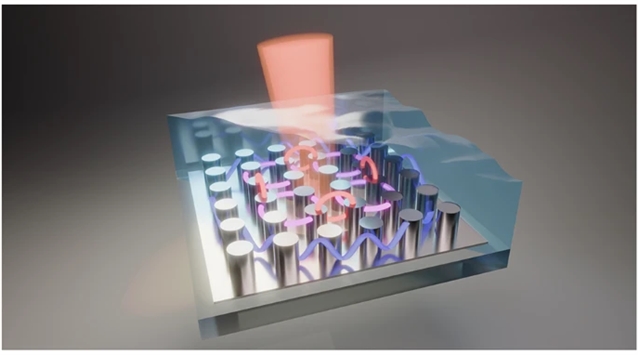
近日,德国汉诺威莱布尼茨大学Antonio Cala Lesina团队研究了介电超表面集体光学共振的强耦合。相关论文于2025年11月24日发表在《光:科学与应用》杂志上。
介电超表面可通过多种集体(非局域)共振实现强光-物质相互作用,包括表面晶格共振(SLRs)和准束缚态在连续区(quasi-BICs)。这些共振的光谱选择性、场增强效应以及高且可控的品质因子(Q值)使其在激光、传感、非线性光学和量子光子源等技术领域具有吸引力。当前新兴挑战聚焦于通过模式耦合与杂化来调控超表面基本共振的光-物质相互作用。尽管已观测到多种共振模式间的强耦合现象,但不同性质的集体共振间的相互作用尚未被报道。
研究组从理论、数值模拟和实验上首次展示了介电超表面中对称性保护的准BIC与SLRs之间的耦合与杂化机制。他们观察到在强耦合机制下,横电极化(TE)激发时出现反交叉(即拉比分裂)并伴随反射抑制;而在弱耦合机制下,横磁极化(TM)照明时因参与共振间的能量交换,表现为偶然BIC的出现。前一现象伴随模式杂化的近场分布。所观测的耦合机制可通过入射角、偏振态及周围环境调控。该研究为集体共振的耦合与杂化提供了基础性见解,可指导设计具有目标准aBIC和集体杂化共振的超表面。该机制还为控制此类共振相关的近场开辟了新途径,在可调谐纳米光子学和光场调控领域具有应用前景。
附:英文原文
Title: Strong coupling of collective optical resonances in dielectric metasurfaces
Author: Allayarov, Izzatjon, Aita, Vittorio, Roth, Diane J., van Casteren, Boaz, Bykov, Anton Yu., Evlyukhin, Andrey B., Zayats, Anatoly V., Cal Lesina, Antonio
Issue&Volume: 2025-11-24
Abstract: Dielectric metasurfaces can achieve strong light-matter interaction based on several types of collective (nonlocal) resonances, such as surface lattice resonances (SLRs) and quasi-bound states in the continuum (quasi-BICs). Spectral selectivity, field enhancement, and high and controllable Q-factors make these resonances appealing for technological applications in lasing, sensing, nonlinear optics, and quantum photon sources. An emerging challenge focuses on tailoring light-matter interaction via mode coupling and hybridisation between the fundamental resonances of a metasurface. While strong coupling phenomena have been demonstrated between various resonant modes, the interplay between collective resonances of different natures has not been observed to date. Here, we theoretically, numerically, and experimentally demonstrate the onset of coupling and hybridisation between symmetry-protected quasi-BICs and SLRs in a dielectric metasurface. We show the emergence of anticrossing (or Rabi splitting) in the strong coupling regime with suppression of reflection, observed under TE-polarised excitation, and the manifestation of an accidental BIC under TM-polarised illumination as a result of energy exchange between the participating collective resonances in the weak coupling regime. The first effect is accompanied by hybridised near fields of the modes. The observed coupling mechanisms can be controlled by modifying the angle of incidence, polarisation, and the surrounding environment. This foundational study on the coupling and hybridisation of collective resonances offers insights that can be leveraged for the design of metasurfaces with targeted quasi-aBIC and collective hybridised resonances. It could also open new possibilities to control the near fields associated with such resonances, with promising applications in tunable nanophotonics and light manipulation. Quasi-BICs and SLRs are typically studied separately. We demonstrate that these two collective resonances can hybridise in dielectric metasurfaces, reaching the strong coupling regime. Controlling such a regime by means of incident polarisation and the surrounding medium leads to a modulation of the system response, opening opportunities for tunable nanophotonics.
DOI: 10.1038/s41377-025-02076-6
Source: https://www.nature.com/articles/s41377-025-02076-6
Light: Science & Applications:《光:科学与应用》,创刊于2012年。隶属于施普林格·自然出版集团,最新IF:19.4
官方网址:https://www.nature.com/lsa/
投稿链接:https://mts-lsa.nature.com/cgi-bin/main.plex