
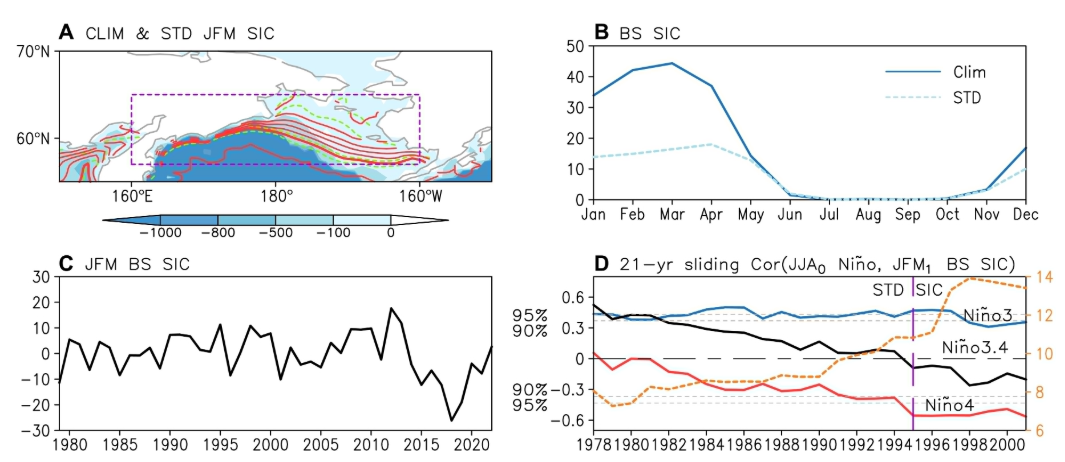
近日,中国科学院南海海洋研究所Sheng Chen团队研究了ENSO对白令海冰的控制变化:北太平洋经向模式的新兴控制。相关论文于2025年11月21日发表在《科学-进展》杂志上。
白令海冬季海冰对区域气候、生态系统和人类生计至关重要,其变化显著受厄尔尼诺-南方涛动(ENSO)影响。
研究组发现了ENSO-白令海冰关系的关键转变:在1990年代中期之前,传统的东太平洋型ENSO主导着正相关的ENSO-海冰关联;而1990年代中期后,频发的中太平洋型ENSO事件将该关系逆转为负相关。观测数据与模式实验表明,中太平洋型厄尔尼诺与正位相北太平洋经向模(NPMM)耦合,会改变向极传播的罗斯贝波列路径,从而增强白令海南风。这种风场变化抑制了海冰平流,加剧暖湿气流入侵,导致海冰消减。
增强的中太平洋型ENSO-NPMM耦合作用及NPMM变率加剧了该遥相关效应,使其对白令海冰的影响较单纯NPMM作用提升38.9%。研究组揭示了副热带与热带太平洋气候相互作用对副极地海冰变率日益增长的影响,强调需改进气候模型以准确刻画ENSO多样性、NPMM动力学及副热带-副极地遥联系,从而提升气候变化背景下白令海冰的预测能力。
附:英文原文
Title: ENSO’s changing grip on Bering Sea ice: The emerging control of the North Pacific meridional mode
Author: Jiepeng Chen, Jin-Yi Yu, Chunzai Wang, Jiping Liu, Xin Wang, Sheng Chen, Lei Zhang, Zhuoqi He
Issue&Volume: 2025-11-21
Abstract: Bering Sea winter sea ice (BSWI), vital for regional climate, ecosystem, and livelihoods, is significantly influenced by El Nio–Southern Oscillation (ENSO). Here, we identify a shift in the ENSO-BSWI relationship. Pre–mid-1990s, traditional eastern Pacific ENSO dominated, driving a positive ENSO-BSWI linkage; post–mid-1990s, more frequent central Pacific (CP) ENSO events reversed this relationship to negative. Observations and model experiments show that CP El Nio coupled with positive-phase North Pacific meridional mode (NPMM) redirects poleward-propagating Rossby wave trains, enhancing Bering Sea southerlies. This suppresses ice advection, intensifies warm air intrusion, and reduces BSWI. Strengthened CP ENSO-NPMM coupling and heightened NPMM variability amplify this teleconnection, increasing its influence on BSWI by 38.9% versus NPMM alone. Our findings underscore the growing role of subtropical and tropical Pacific climate interactions in subarctic sea ice variability and highlight the need for improved climate models that capture ENSO diversity, NPMM dynamics, and subtropical-subarctic teleconnections to enhance BSWI projections under climate change.
DOI: ady2329
Source: https://www.science.org/doi/10.1126/sciadv.ady2329