
近日,中国海洋大学陈显尧团队报道了来自深大西洋的热量传递增强了北冰洋的变暖。相关论文于2025年11月21日发表在《科学-进展》杂志上。
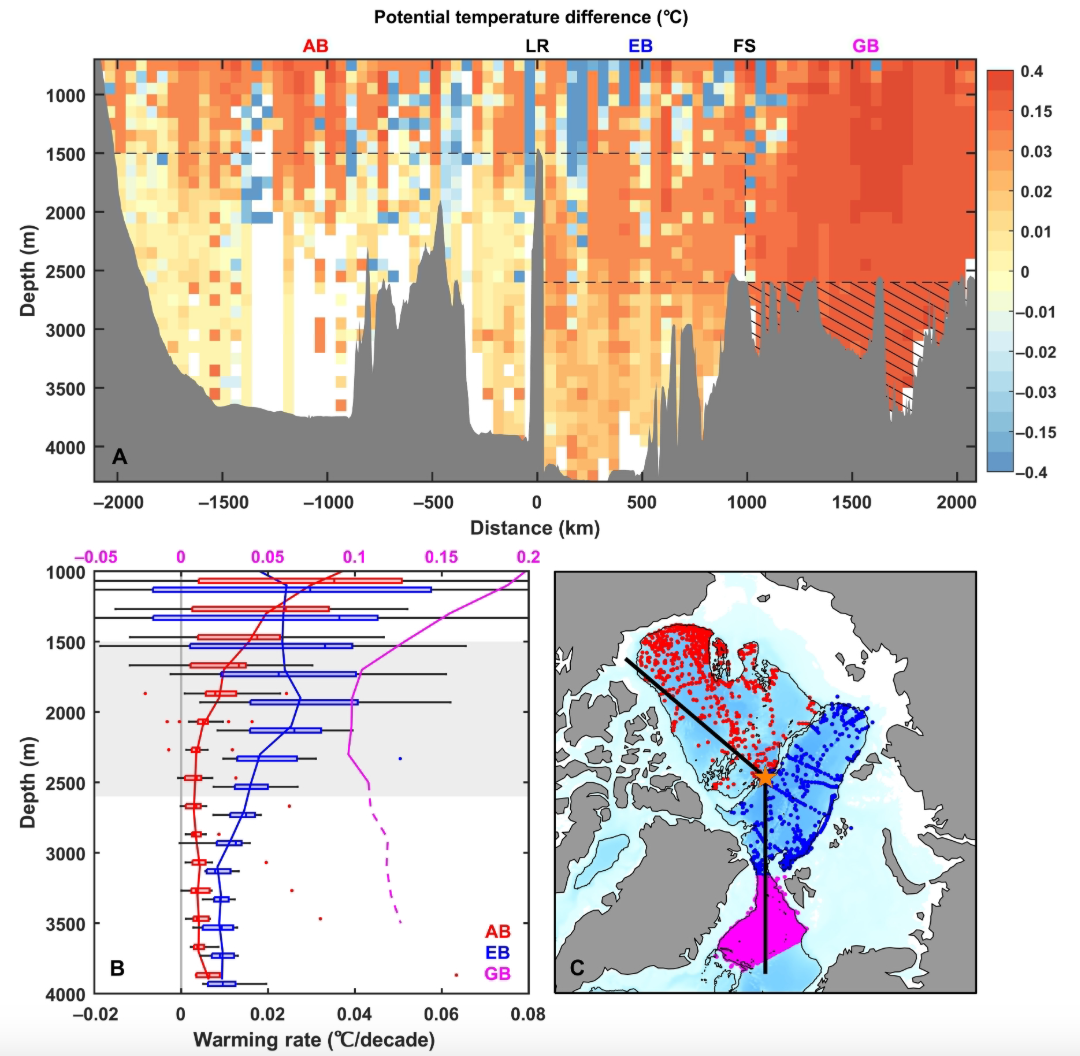
自20世纪90年代以来的观测显示,北冰洋深层和底层水体正经历普遍增温。这一现象历来被归因于地热加热,而全球和北极气候变化对北冰洋深层增温的影响尚未明确。研究组表明,近几十年来在2000-2600米水深的欧亚海盆,北冰洋深层水体以每十年0.020℃的速率持续升温,该速率已超出地热加热所能解释的范围。
研究组发现格陵兰海盆深层的快速增温通过弗拉姆海峡削弱了其对欧亚海盆深层的冷却效应,从而引发后者的升温。同时,罗蒙诺索夫海脊阻挡了该增温信号向美亚海盆深层的传递,使其保持每十年0.003℃的相对缓慢增温速率。该发现表明,格陵兰海盆深层增温已对北冰洋深层水体产生显著影响。
附:英文原文
Title: Deep Arctic Ocean warming enhanced by heat transferred from deep Atlantic
Author: Ruizhe Song, Xianyao Chen, Hanwen Bi, Xiaoyu Wang, Longjiang Mu
Issue&Volume: 2025-11-21
Abstract: Observations since the 1990s reveal widespread warming in the deep and bottom Arctic Ocean. It is historically attributed to geothermal heating, whereas the impacts of global and Arctic climate change on the deep and bottom Arctic Ocean warming remain unresolved. Our study demonstrates that during the recent decades, the Arctic Ocean deep water is warming at 0.020°C/decade in the Eurasian Basin between 2000 and 2600 m, exceeding what can be explained by geothermal heating. We find that the rapid warming in the deep Greenland Basin diminishes its cooling effect on the deep Eurasian Basin via the Fram Strait, leading to the warming in the deep Eurasian Basin. Meanwhile, the Lomonosov Ridge blocks this warming signal from reaching the deep Amerasian Basin, maintaining its relative slow warming rate of 0.003°C/decade. Our findings indicate that the deep Greenland Basin warming has already exerted obvious impacts on the deep Arctic Ocean.
DOI: adx9452
Source: https://www.science.org/doi/10.1126/sciadv.adx9452