
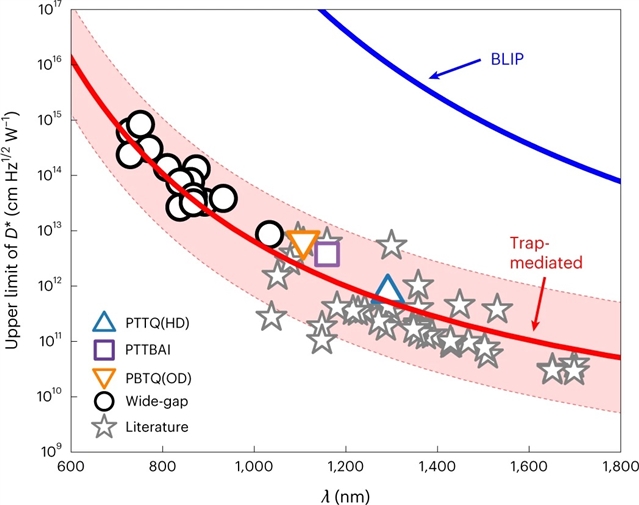
近日,英国斯旺西大学Ardalan Armin课题组与比利时哈塞尔特大学的Koen Vandewal等人合作,发现了有机光电二极管中间隙阱状态介导暗电流。相关研究成果已于2023年3月23日在国际权威学术期刊《自然—光子学》上发表。
该课题组提出了有机光电二极管(OPDs)中暗饱和电流在本质上受到中间能隙势阱态的限制。这个新观点是基于对大量OPDs暗饱和电流的普遍趋势观察得出,并通过敏感的外量子效率和温度依赖电流测量得到了进一步证实。基于这个观点,建立了特定检测能力的上限。了解任何探测器中噪声来源的细节对于定义性能限制是非常重要的,因此对于所有应用来说,材料和器件选择、设计和优化至关重要。他们的工作为OPDs建立了这些重要原则。
据悉,光电二极管在工业和消费电子中随处可见。不断涌现的光电二极管新应用需要与传统无机半导体器件提供的机械和光电特性不同的性能。这刺激了人们对有机半导体的使用产生了相当大的兴趣,有机半导体提供了丰富的可用光电特性,可以纳入柔性形态因素几何形状,并可以使用丰富材料进行低成本、低体积能量制造。光电二极管的灵敏度关键取决于暗电流。然而,有机光电二极管(OPDs)的暗电流明显比热激发辐射跃迁所预期的要高得多。
附:英文原文
Title: Mid-gap trap state-mediated dark current in organic photodiodes
Author: Sandberg, Oskar J., Kaiser, Christina, Zeiske, Stefan, Zarrabi, Nasim, Gielen, Sam, Maes, Wouter, Vandewal, Koen, Meredith, Paul, Armin, Ardalan
Issue&Volume: 2023-03-23
Abstract: Photodiodes are ubiquitous in industry and consumer electronics. Constantly emerging new applications for photodiodes demand different mechanical and optoelectronic properties from those provided by conventional inorganic-based semiconductor devices. This has stimulated considerable interest in the use of organic semiconductors, which provide a vast palette of available optoelectronic properties, can be incorporated into flexible form factor geometries, and promise low-cost, low-embodied energy manufacturing from earth-abundant materials. The sensitivity of a photodiode depends critically on the dark current. Organic photodiodes (OPDs), however, are characterized by a much higher dark current than expected for thermally excited radiative transitions. Here we show that the dark saturation current in OPDs is fundamentally limited by mid-gap trap states. This new insight is generated by the universal trend observed for the dark saturation current of a large set of OPDs and further substantiated by sensitive external-quantum-efficiency- and temperature-dependent current measurements. Based on this insight, an upper limit for the specific detectivity is established. A detailed understanding of the origins of noise in any detector is fundamental to defining performance limitations and thus is critical to materials and device selection, and design and optimization for all applications. Our work establishes these important principles for OPDs.
DOI: 10.1038/s41566-023-01173-5
Source: https://www.nature.com/articles/s41566-023-01173-5