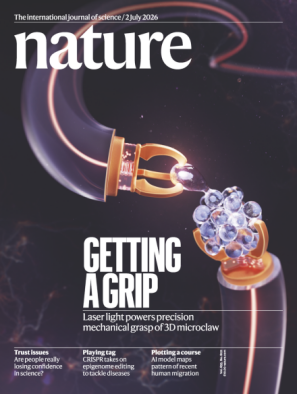
Nature, 2 July 2026,Volume 655,Issue 8121
《自然》2026年7月2日,第655卷,8121期
物理学Physics
GW250114 reveals signatures of post-merger black-hole horizon
GW250114揭示并合后黑洞视界的特征信号
▲ 作者:Neil Lu, Sizheng Ma, Ornella J. Piccinni, Yanbei Chen & Ling Sun
▲链接:
https://www.nature.com/articles/s41586-026-10696-0
▲摘要:
黑洞的视界,即“不归之面”,以其旋转频率ΩH和表面引力κ为特征。一个引人注目的标志是,任何落入其中的物体会因参考系拖曳效应而看似以ΩH绕转,同时其发出的信号会因引力红移而以由κ决定的速率指数衰减。
近期理论工作预言,双黑洞并合产生的引力波会携带有并合残骸性质的直接印记,表现为一种“直达波”。该引力波分量在2ΩH附近振荡,反映了视界的参考系拖曳,并以由κ决定的递增速率衰减,同时受到黑洞时空的额外屏蔽。
研究者报告了在GW250114中观测到的直达波证据,其在LIGO汉福德(利文斯顿)探测器中90%置信水平的匹配滤波信噪比为{15.8}{-0.5}^{+0.1}({17.1}{-0.4}^{+0.1})。
测量性质与克尔黑洞的理论预言完全一致。这些发现建立了一条观测通道,可直接测量黑洞能层中的参考系拖曳效应,并探索动态强引力区中的(近)视界物理。
▲ Abstract:
The horizon of a black hole, the ‘surface of no return’, is characterized by its rotation frequency ΩH and surface gravity κ. A striking signature is that any infalling object appears to orbit at ΩH owing to frame dragging, while its emitted signals decay exponentially at a rate set by κ as a consequence of gravitational redshift. Recent theoretical work1 predicts that gravitational waves from binary black-hole mergers carry direct imprints of the properties of the merger remnant in the form of a ‘direct wave’. This gravitational-wave component oscillates near 2ΩH, reflecting the horizon’s frame dragging, and decays at an increasing rate characterized by κ, with additional screening from the black hole’s spacetime. Here we report observational evidence of a direct wave in GW2501142, with a 90% credible matched-filter signal-to-noise ratio of {15.8}_{-0.5}^{+0.1} ({17.1}_{-0.4}^{+0.1}) in the LIGO Hanford (Livingston) detector. The measured properties are in full agreement with theoretical predictions for a Kerr black hole. These findings establish an observational channel to directly measure frame-dragging effects in black-hole ergospheres and explore (near-)horizon physics in dynamical, strong-gravity regimes.
Aerosols and hydrocarbons in the atmosphere of a white dwarf planet
白矮星行星大气中的气溶胶与碳氢化合物
▲ 作者:Ryan J. MacDonald, Christopher E. O’Connor, Victoria A. Boehm, E. M. May, David K. Sing, Elijah Mullens, L. C. Mayorga, Trevor O. Foote, Simon Blouin, Logan A. Pearce, Nikole K. Lewis, Jeff Valenti, Natasha E. Batalha, Maura Lally, Joshua D. Lothringer, Mark S. Marley, Ishan Mishra & Susan E. Mullally
▲链接:
https://www.nature.com/articles/s41586-026-10514-7
▲摘要:
包括太阳在内的大多数恒星,终有一天会演化为红巨星,随后成为白矮星。近期已发现若干颗行星候选体绕白矮星运行,这表明行星能够在恒星主序后阶段完整幸存。关于主序后行星的大气成分我们知之甚少,目前拥有大气探测的最演化凌星行星均绕亚巨星运行。
研究者报告了白矮星行星WD 1856 b的大气探测结果,该探测通过詹姆斯·韦布空间望远镜近红外光谱仪PRISM模式的透射光谱实现。光谱分析将WD 1856 b的质量限制在4.3–10.9 M_J,发现其大气富碳(CH 丰度约7%),且有效温度超过预期的行星平衡温度(390–412 K对160 K)。
基于冷却模型,这些结果表明WD 1856 b在白矮星阶段持续了3.0–5.5 Gyr后经历了一次与迁移相关的再加热事件,这与主序后潮汐演化至现今0.02 AU圆轨道的图景一致。该结果为质量与太阳相近的恒星周围巨行星的最终命运提供了一个观测窗口。
▲ Abstract:
Most stars, including our Sun, will one day evolve into red giants and, subsequently, white dwarfs. Several planet candidates have recently been identified orbiting white dwarfs, demonstrating that planets can survive the stellar post-main-sequence stage intact. Little is known about the atmospheric composition of post-main-sequence planets, with the most evolved transiting planets with atmospheric detections so far orbiting subgiants5,6. Here we report an atmospheric detection for the white dwarf planet WD 1856 b, achieved through transmission spectroscopy with the James Webb Space Telescope (JWST) Near-Infrared Spectrograph (NIRSpec) PRISM.Our spectral analysis constrains the mass of WD 1856 b to 4.3–10.9 MJ, finds a carbon-enriched atmosphere (with a CH4 abundance of approximately 7%) and an effective temperature exceeding the expected planetary equilibrium temperature (390–412 K versus 160 K). On the basis of cooling models, these results indicate that WD 1856 b underwent a migration-related reheating event 3.0–5.5 Gyr into the white dwarf phase, consistent with post-main-sequence tidal evolution to the present-day 0.02-AU circular orbit. Our results provide a window into the ultimate fate of giant planets orbiting stars with masses similar to our Sun.
Fourier pixels for bidirectional light control
用于双向光控制的傅里叶像素
▲ 作者:Yannik M. Glauser, Sander J. W. Vonk, David B. Seda, Hannah Niese, Boris de Jong, Matthieu F. Bidaut, Erwan Bossavit, Daniel Petter, Gabriel Nagamine, Nolan Lassaline & David J. Norris
▲链接:
https://www.nature.com/articles/s41586-026-10681-7
▲摘要:
数码相机和显示器使用仅执行单一功能的像素:检测或发射光强度。为了充分利用电磁波的全部信息内容,需要更先进的元件。这推动了多功能组件的发展,例如能够同时检测和发射强度,或提取强度和光谱信息的组件。
然而,目前尚不存在既能够感知又能够生成光学波前,且对振幅、相位和偏振具有完全控制能力的像素,从而限制了复杂光场的双向控制和反馈。
研究者在此通过展示一个基于傅里叶光学的小型化衍射元件的多功能平台,提出了一条实现此类像素的途径。他们利用等离子体表面波,在金属表面上相干且高效传播。
当这些等离子体激元被发射向经过简单傅里叶分析设计的波浪形微结构时,可以产生任意且无背景的光学波前。相反,入射光可以被感知,并对其振幅、相位和偏振进行全面表征。
通过组合或叠加多个此类组件,研究者创建了多功能的“傅里叶像素”,能够紧凑而精确地控制光场。他们将其扩展至光子波导模式,建立了一种可扩展的通用架构,用于矢量可编程像素,可应用于自适应光学、全息显示、光通信和量子信息处理。
▲ Abstract:
Digital cameras1 and displays use picture elements (pixels3) that perform a single function: detecting or emitting light intensity. To exploit the full information content of electromagnetic waves, more advanced elements are required. This has driven the development of multifunctional components that, for example, simultaneously detect and emit intensity4,5 or extract intensity and spectral information. However, no pixel exists that both senses and generates optical wavefronts with full control over amplitude, phase and polarization, limiting bidirectional control and feedback of sophisticated light fields. Here we present a route to such pixels by demonstrating a versatile platform of miniaturized diffractive elements based on Fourier optics. We use plasmonic surface waves, which propagate coherently11 and efficiently across metallic surfaces. When these plasmons are launched towards wavy microstructures16 designed with simple Fourier analysis, arbitrary and background-free optical wavefronts are generated. Conversely, incoming light can be sensed, and its amplitude, phase and polarization can be fully characterized. By combining or superposing several such components, we create multifunctional ‘Fourier pixels’ that provide compact and accurate control over the optical field. Our approach, which we extend to photonic waveguide modes, establishes a scalable, universal architecture for vectorially programmable pixels with applications in adaptive optics, holographic displays, optical communication and quantum information processing.
Optical fibre gripper for high-performance 3D micromanipulation
用于高性能三维微操作的光纤夹持器
▲ 作者:Deng Pan, Kaiwen Liang, Chen Xin, Lei Zhong, Shaojun Jiang, Chenchu Zhang, Liang Yang, Zhiqiang Wang, Zhaoxin Lao, Jincheng Ni, Chaowei Wang, Jiawen Li, Shenglai Zhen, Benli Yu, Zhixiang Huang, Fang-Wen Sun, Jiaru Chu, Yanlei Hu, Li Zhang & Dong Wu
▲链接:
https://www.nature.com/articles/s41586-026-10673-7#Bib1
▲摘要:
光镊提供精确的非接触控制,但其力操控范围有限,且对目标特性和环境条件有严格的要求。毫米级机械夹持器可提供更高的夹持力,但不适用于精确操作。将微夹持器直接集成于光纤端面为精确微操作提供了一条新途径。
然而,现有的光纤集成夹持器仍面临在狭窄空间内实现对微小物体(如单细胞)高性能操控的挑战,这主要归因于其结构简化、设计受限以及毫米级的尺寸。
研究者报道了一种三维光纤夹持器,通过两步双光子聚合制备而成。该OFG由刚性光刻胶微爪和掺杂银纳米颗粒的热响应水凝胶肌肉组成,尺寸仅为38 × 38 × 61 μm3。该OFG的力质量比约为340 μN mg-1,比此前报道的光纤集成夹持器高出1至2个数量级。该OFG可操控不透明颗粒、不规则微机械组件以及多种单细胞类型。
他们进一步展示了其在复杂微型器件(轴承、轴和齿轮箱)三维微组装以及在狭窄环境(<300 μm)中仿生取样方面的应用潜力。这些结果表明,OFG作为一种紧凑型光纤端面操作器,适用于三维微操作,在光场捕获与毫米级机械夹持器之间的中间力区间内提供可逆且可调的夹持力。
▲ Abstract:
Optical tweezers offer precise, non-contact control, but operate in a limited force regime and impose strict requirements on the characteristics of the targets as well as the environmental conditions. Millimetre-scale mechanical tweezers can offer higher gripping force but are not suitable for precise manipulations. Integrating microgrippers directly at the optical fibres provides a new approach for precise micromanipulation. However, existing fibre-integrated tweezers still face challenges in achieving high-performance manipulation of micro-objects (for example, single cells) within narrow spaces, mainly due to simplified architectures, constrained designs and millimetre-scale footprints12,13,14. Here we report a three-dimensional (3D) optical fibre gripper (OFG), which is fabricated by two-step, two-photon polymerization. The OFG consists of rigid photoresist microclaws and soft thermoresponsive hydrogel muscle doped with silver nanoparticles, and its size is only 38 × 38 × 61 μm3. The OFG exhibits a force-to-mass ratio of about 340 μN mg-1, outperforming previously reported fibre-integrated tweezers by one to two orders of magnitude. The OFG can manipulate opaque particles, irregular micromechanical components and diverse single-cell types. We further demonstrated its potential in 3D microassembly of complex microdevices (bearings, shafts and gearboxes) and biomimetic sampling in the narrow environment (<300 μm). These results position the OFG as a compact fibre-tip manipulator for 3D micromanipulation, offering reversible and tunable gripping in an intermediate force regime between optical field trapping and millimetre-scale mechanical tweezers.
物理化学Physical Chemistry
Ductile alloys offering 100 MPa tensile strength at 2,400°C
2400摄氏度下抗拉强度达100兆帕的高韧性合金
▲ 作者:Mintao Xue, Suzhi Li, Jing Wang, Jinyang Li, Xiangdong Ding, En Ma & Jun Sun
▲链接:
https://www.nature.com/articles/s41586-026-10708-z
▲摘要:
极端应用需要材料不仅要在超过2000℃的温度下具有足够强度以承受热机械载荷,而且还需在室温下具备良好的可成形性,以便加工成复杂形状部件。
后者排除了脆性陶瓷和金属间化合物,将选择范围限制在高延展性金属及其合金,但对于这些材料而言,在超高温下获得足够的强度似乎遥不可及。
研究者展示了一种铸造合金的突破性进展,该合金同时实现了这两项性能。我们利用一种新的硼介入原位氧化反应,精心制备了硼稳定HfO2强化钽基合金,生成了直径约50 nm、在晶粒内部弥散均匀分布的氧化物颗粒。
这种新型合金填补了超高温区拉伸屈服强度的空白,在2000℃时约为200 MPa,在2400℃时约为100MPa,同时室温下兼具优异的强度–延性平衡(极限抗拉强度>800 MPa,断裂延伸率约35%),这一性能组合超越了所有以往的难熔合金(包括多主元合金)。
此外,氧化物纳米颗粒周围的硼偏析使其在2000–2400℃范围内具有优异的抗粗化热稳定性。因此,该策略超越了传统的氧化物弥散强化,使高延展性难熔合金能够在极端温度下承载负荷。
▲ Abstract:
Extreme applications call for materials that are not only strong to withstand thermomechanical loads at temperatures in excess of 2,000°C, but also highly formable at room temperature to allow for processing into complex-shaped parts. The latter excludes brittle ceramics4 and intermetallic compounds5, limiting the selection to highly ductile metals and their alloys, but for them, an adequate strength at ultrahigh temperatures seems unreachable. Here we show a breakthrough in casting alloys that achieve both simultaneously. A boron-stabilized HfO2-strengthened Ta-based alloy was carefully crafted using a new boron-intervened in situ oxidation reaction, producing about 50-nm diameter oxide particles dispersed densely and uniformly in the grain interior. The new alloy fills the blank at ultrahigh temperatures in terms of tensile yield strength, around 200 MPa at 2,000°C and 100 MPa at 2,400°C, while simultaneously possessing an excellent strength–ductility balance at room temperature (ultimate tensile strength >800 MPa, elongation-to-failure of about 35%), a property combination surpassing all previous refractory (including multi-principal-element) alloys. Moreover, the boron segregation around the oxide nanoparticles imparts excellent thermal stability against coarsening at 2,000–2,400°C. Our strategy thus goes beyond traditional oxide-dispersion strengthening to enable highly ductile refractory alloys that are capable of load-bearing applications at extreme temperatures.
Fast formation to reinforce lithium-rich cathodes
快速化成以强化富锂正极
▲ 作者:Mengjian Fan, Jiantao Li, Guiyang Gao, Benli Jiang, Longlong Fan, Qingxi Yuan, Yinggan Zhang, Hongfei Zheng, Saichao Li, Liang Lin, Zonghai Chen, Yang Ren, Yuanyuan Liu, Wei He, Gaosheng Chen, Baisheng Sa, Laisen Wang, Jie Lin, Dong-Liang Peng & Qingshui Xie
▲链接:
https://www.nature.com/articles/s41586-025-09553-3
▲摘要:
锂离子电池制造中的化成通常涉及低倍率充放电循环,以建立稳定的电极–电解质界面——这是一个耗时的过程。
研究者针对富锂层状氧化物正极的研究结果挑战了传统化成的必要性,后者甚至可能缩短电池寿命。相反,快速化成可降低生产成本并提升容量和稳定性。
基于多尺度同步辐射技术的表征表明,首次充电后残留的锂离子对后续结构演变和循环性能至关重要。深度脱锂会因本质上脆弱的缺锂骨架而导致严重的结构退化和容量损失。
相比之下,快速化成带来的残留锂离子通过自钉扎效应增强了可逆性,抑制了有害的晶格变形并强化了离子存储框架。将首次充电电流密度从0.2C调整至2C,可使可逆容量提高20%,循环寿命延长超过36%。该方法还可推广至其他电极体系,为更高效的电池生产提供了新思路。
▲ Abstract:
Formation in lithium-ion battery manufacturing typically involves low-rate charge–discharge cycles to establish stable electrode–electrolyte interfaces—a time-consuming process. Here, our findings on lithium-rich layered oxide cathodes challenge the necessity of conventional formation, which can even shorten battery lifespan. Fast formation, on the other hand, reduces production cost and enhances capacity and stability. Multiscale synchrotron-based techniques show that residual lithium ions after the initial charge are critical for subsequent structural evolution and cycling performance. Deep lithium de-intercalation causes severe structural degradation and capacity loss due to the inherently fragile lithium-deficient matrix. By contrast, the residual lithium ions from fast formation enhance reversibility through a self-pinning effect, preventing pernicious lattice deformation and reinforcing the ion-storage framework. Adjusting the initial charge current density from 0.2 C to 2 C improves reversible capacity by 20% and extends cycle life by more than 36%. This approach can also be extended to other electrode systems, providing insights for more-efficient battery production.
特别声明:本文转载仅仅是出于传播信息的需要,并不意味着代表本网站观点或证实其内容的真实性;如其他媒体、网站或个人从本网站转载使用,须保留本网站注明的“来源”,并自负版权等法律责任;作者如果不希望被转载或者联系转载稿费等事宜,请与我们接洽。