编译|冯维维
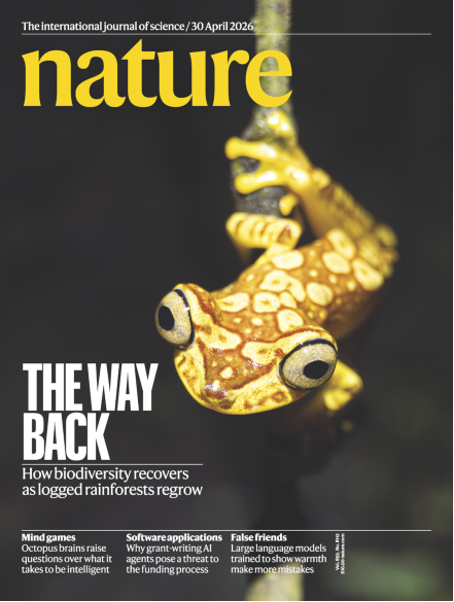
Nature, 30 April 2026, Volume 652 Issue 8112 《自然》2026年4月30日,第652卷,8112期
物理学Physics
Switchable 2D–3D display through a metasurface lenticular lens
超表面柱透镜实现可切换二维—三维显示
▲ 作者:Seokil Moon, Joohoon Kim, Youngjin Jo, Juwon Seo, Kyungtae Kim, Seokwoo Kim, Chang-Kun Lee & Junsuk Rho
▲ 链接:
https://www.nature.com/articles/s41586-026-10318-9
▲ 摘要: 三维(3D)显示可通过提供深度视觉线索带来沉浸式观感,在交互媒体等领域具备重要应用价值。为提升实用化程度,二维—三维可切换显示能够在单一设备中灵活切换高分辨率二维显示模式与沉浸式三维显示模式。研究者提出一种基于超表面柱透镜(MLL) 的全彩二维—三维可切换光场显示技术。该超表面柱透镜可依据入射光的偏振特性切换聚焦特性,以此作为实现二维、三维模式切换的核心机理。
研究设计的超表面柱透镜具备高数值孔径特性,在仅有1.2毫米超薄厚度的前提下,实现了高达100°的广视角。研究制备出有效面积达25平方厘米的大尺寸超表面柱透镜,并将其无缝集成作为二维/三维双模切换光学器件,验证了该技术在大面积显示场景中的可拓展应用潜力。将制备完成的器件简易贴合至有机发光二极管显示屏后,可清晰呈现二维与三维图像,且能够通过施加电压实现模式主动切换。研究为面向消费电子与商用场景的下一代显示技术提供了极具前景的技术方案。
▲ Abstract: Three-dimensional (3D) displays provide immersive visuals by delivering depth cues, making them valuable for applications such as interactive media. To enhance practicality, 2D–3D switchable displays offer the flexibility to toggle between high-resolution 2D and immersive 3D modes in a single device. Here we propose a full-colour 2D–3D switchable light-field display powered by a metasurface lenticular lens (MLL). The MLL switches its focal behaviour on the basis of the polarization of incident light, serving as the core mechanism for 2D–3D mode transition. The MLL is designed with a high numerical aperture, enabling a notably wider field of view of 100° while maintaining an ultrathin profile of just 1.2?mm. A large-area MLL with an active area of 25?cm2 is fabricated and seamlessly integrated as a dual-dimension switchable optics device, demonstrating the scalability of the approach for wide-area display applications. The fabricated device, when simply mounted onto an organic light-emitting diode display panel, successfully demonstrates clear 2D and 3D images, along with the active switching functionality enabled by applied voltage. These results highlight a promising solution for next-generation display technologies in both consumer electronics and commercial applications.
300-unit-per-second roll-to-roll manufacturing of visible metalenses
以每秒300个单元的卷对卷工艺制造可见光超透镜
▲ 作者:Trung Hoang, Yujin Park, Joohoon Kim et al.
▲ 链接:
https://www.nature.com/articles/s41586-026-10369-y
▲摘要:过去十年来,超表面因其在亚波长尺度上操控光线的能力而得到广泛研究。近期最关键的进展之一是可规模化制造,这为超表面的商业化及工业应用铺平了道路。然而,迄今为止超表面的生产吞吐量大多仍停留在学术水平,限制了其实际部署。研究展示了用于可见光超透镜的卷对卷纳米压印技术,实现了大规模、低成本、全自动化且具备工业级吞吐量的制造。
该系统达到了每秒300个超透镜的生产速率,成本与传统折射光学元件相当甚至更低。通过原子层沉积技术,他们沉积了一层保形的高折射率二氧化钛薄膜,从而显著提升了光学性能。实验表征证实,整个图案化区域均具有高光学效率和高均匀性,并持续保持高良率。研究展示了超表面技术从学术研究走向现实世界的潜力。
▲ Abstract: Metasurfaces have been extensively studied over the past decade for their ability to manipulate light at subwavelength scales. One of the most critical trends emerging recently has been scalable manufacturing, which is paving the way for the commercialization and industrial adoption of metasurfaces. However, the production throughput of metasurfaces has so far largely remained at the academic level, limiting their practical deployment. Here we demonstrate the roll-to-roll nanoimprinting of visible metalenses for large-scale, cost-effective and fully automated manufacturing at industrial-level throughput. Our system achieves a production rate of 300 metalenses per second, with a cost comparable with—or even lower than—that of conventional refractive optics. A conformal high-index titanium dioxide layer is deposited via atomic layer deposition to dramatically enhance optical performance. Experimental characterization confirms high optical efficiency and uniformity across the full patterned area, with consistently high yields. This work shows potential for the transition of metasurface technology from academic research to the real world.
化学Chemistry
Ceramic-like strength and metallic toughness in a bulk metallic glass
兼具类陶瓷强度与金属型韧性的块体金属玻璃
▲ 作者:Zhengqing Cai, Shidong Feng, Zhen-Qiang Song et al.
▲ 链接:
https://www.nature.com/articles/s41586-026-10430-w
▲ 摘要: 金属与陶瓷各有其固有的局限性——金属强度较低且高温稳定性差,而陶瓷则天生脆性。寻找兼具高强度、高断裂韧性与热稳定性的材料仍然是一个重要的科学目标。研究者展示了一种Re–Co–Ta–B块体金属玻璃,它克服了这一基本局限,实现了约6.43 GPa的卓越断裂强度,同时保持约30 MPa·m^{1/2}的断裂韧性。这一强度值超过了此前报道的块体金属玻璃和晶态金属,接近先进陶瓷的强度,同时在韧性方面远超后者。该合金表现出显著的热软化抵抗能力和恶劣环境耐受性,在900 K下仍能保持4.4 GPa的强度,且氧化和腐蚀极轻微。
同步辐射测量和像差校正显微分析揭示了这些性能的起源:一种独特的非晶结构,其继承了Re?B?金属间化合物相的高度类晶体的短程有序结构。第一性原理计算表明,这个原子骨架通过嵌入金属基质中的定向Re–B共价键得到强化,从而在陶瓷键合与金属键合之间架起了桥梁。该研究提出的结构遗传性可作为设计具有前所未有性能组合的下一代非晶材料的指导原则。
▲ Abstract: Metals and ceramics have contrasting limitations—metals exhibit lower strength and poor high-temperature stability, whereas ceramics are inherently brittle. Materials combining high strength, fracture toughness and thermal stability remain an important scientific objective. Here we report Re–Co–Ta–B bulk metallic glasses (BMGs) that overcome this fundamental limitation, achieving a remarkable fracture strength of about 6.43?GPa while maintaining around 30?MPa?m1/2 fracture toughness. This strength value exceeds previously reported values for BMGs and crystalline metals and approaches the strength of advanced ceramics while far exceeding them in toughness. These alloys exhibit pronounced resistance to thermal softening and harsh environments, retaining a strength of 4.4?GPa at 900?K with negligible oxidation and corrosion. Synchrotron measurements and aberration-corrected microscopy reveal the origin of these properties: a unique amorphous structure that inherits a high degree of crystal-like short-range order from the Re7B3 intermetallic phase. First-principles calculations indicate that this atomic framework is strengthened by directional Re–B covalent bonds embedded in a metallic matrix, thereby bridging the ceramic and metallic bonding. This work suggests structural heredity as a guiding principle for engineering next-generation amorphous materials with previously unattainable property combinations.
生命科学Life Science
CSN5i-3 is an orthosteric molecular glue inhibitor of COP9 signalosome
CSN5i-3是一种靶向COP9信号小体的正构分子胶抑制剂
▲ 作者:Huigang Shi, Xiaorong Wang, Clinton Yu et al.
▲ 链接:
https://www.nature.com/articles/s41586-026-10129-y
▲ 摘要: 正构抑制剂通过阻断酶活性位点来阻止底物结合。通过底物依赖性来增强其特异性似乎本质上不太可能,因为其作用机制依赖于直接竞争而非选择性识别。研究发现,一种分子胶机制意外地赋予了CSN5i-3(一种 COP9 信号小体的正构抑制剂)底物依赖性的效能。研究者首先证实,CSN5i-3通过占据其催化亚基CSN5的活性位点,直接与异肽键底物竞争,从而抑制了催化 cullin-RING 泛素连接酶上的NEDD8去偶联反应的CSN。值得注意的是,这种正构抑制剂与游离CSN的结合亲和力仅为微摩尔级,但在阻断其去NEDD化酶活性时却达到了纳摩尔级的效能。
酶—底物—抑制剂复合物的冷冻电镜结构显示,与活性位点结合的CSN5i-3 在封闭底物异肽键连接的同时,还延伸了CSN5上的一个 N8 结合外位点,起到分子胶的作用,巩固了N8与CSN5之间的相互作用。这种三分子CSN5i-3-N8-CSN5复合物的协同组装,反过来将CSN5i-3锚定在其结合位点上,使得这种正构抑制剂尽管对游离酶的亲和力较低,却具有高效能。
研究结果揭示了分子胶对单个靶蛋白的亲和力要求其实不高,并将正构分子胶抑制剂确立为一类新型的底物依赖性酶拮抗剂。
▲ Abstract: Orthosteric inhibitors block enzyme active sites and prevent substrates from binding1. Enhancing their specificity through substrate dependence seems inherently unlikely, as their mechanism hinges on direct competition rather than selective recognition. Here we show that a molecular glue mechanism unexpectedly imparts substrate-dependent potency to CSN5i-3, an orthosteric inhibitor of the COP9 signalosome (CSN). We first confirm that CSN5i-3 inhibits CSN, which catalyses NEDD8 (N8) deconjugation from the cullin-RING ubiquitin ligases, by occupying the active site of its catalytic subunit, CSN5, and directly competing with the iso-peptide bond substrate. Notably, the orthosteric inhibitor binds free CSN with only micromolar affinity, yet achieves nanomolar potency in blocking its deneddylase activity. Cryogenic electron microscopy structures of the enzyme–substrate–inhibitor complex reveal that active site-engaged CSN5i-3 occludes the substrate iso-peptide linkage while simultaneously extending an N8-binding exosite of CSN5, acting as a molecular glue to cement the N8–CSN5 interaction. The cooperativity of this trimolecular CSN5i-3–N8–CSN5 assembly, in turn, sequesters CSN5i-3 at its binding site, conferring high potency to the orthosteric inhibitor despite its low affinity for the free enzyme. Together, our findings highlight the modest affinity requirements of molecule glues for individual target proteins and establish orthosteric molecular glue inhibitors as a new class of substrate-dependent enzyme antagonists.
Peripheral immune-inducer dendritic cells drive early-life allergic inflammation
外周免疫诱导树突状细胞驱动早期过敏性炎症
▲ 作者:Yue Xing, Ilana Reznikov, Abonti Nur Ahmed et al.
▲ 链接:
https://www.nature.com/articles/s41586-026-10162-x
▲摘要:与过敏原相关的特应性疾病以及过敏性疾病常常发生在生命早期;然而,控制生命早期对过敏原免疫反应的年龄依赖性机制仍知之甚少。研究发现,在生命早期接触常见过敏原会触发一种独特的分叉免疫反应:一方面在皮肤中引发17型炎症反应,同时也在淋巴结中启动经典的2型辅助性T细胞致敏。这种早期生命期的γδ17型细胞介导的皮炎,会在再次接触过敏原时加剧过度的过敏性肺部炎症。
在机制上,研究发现树突状细胞介导的17型激活直接发生在皮肤中,无需迁移至淋巴结;他们将这种状态的细胞命名为"外周免疫诱导"树突状细胞。CD301b+的常规2型树突状细胞捕获过敏原后,转变为pii-DC状态,产生IL-23,并独立于淋巴结而激活局部的γδ 17型细胞。pii-DC状态的出现是由早期生命期特有的未成熟下丘脑—垂体—肾上腺轴以及生理性低水平的系统性糖皮质激素所促成的;树突状细胞特异性敲除糖皮质激素受体可重现pii-DC表型。这些发现定义了一个由神经内分泌成熟设定的发育检查点,该检查点能够实现原位树突状细胞激活和免疫诱导,从而塑造了年龄依赖性的过敏原反应模式。
▲ Abstract: Atopic diseases associated with allergens, as well as allergic diseases, frequently arise early in life; however, the age-dependent mechanisms governing immune responses to allergens remain poorly understood1. Here we find that in early life, exposure to common allergens triggers a distinct bifurcated immune response, simultaneously triggering type 17 inflammation in the skin and initiating canonical T helper 2 sensitization in the lymph nodes. This early-life γδ type 17-mediated dermatitis primes the exaggerated allergic lung inflammation upon secondary allergen exposure. Mechanistically, we find dendritic cell (DC)-mediated type 17 activation directly in the skin without requiring migration to lymph nodes; we term this state ‘peripheral immune inducer’ (pii) DC. CD301b+ conventional type 2 DCs acquire allergen, adopt the pii-DC state, produce IL-23 and activate local γδ type 17 cells independently of lymph-node engagement. The pii-DC state is enabled by the immature hypothalamic–pituitary–adrenal axis and physiologically low systemic glucocorticoids characteristic of early life2,3; DC-specific deletion of the glucocorticoid receptor recapitulates the pii-DC phenotype. These findings define a developmental checkpoint, set by neuroendocrine maturation, that enables in situ DC activation and immune induction, thereby shaping age-dependent responses to allergens.
生物多样性Biodiversity
Biodiversity resilience in a tropical rainforest
热带雨林的生物多样性恢复力
▲ 作者:Timo Metz, Nina Farwig, Carsten F. Dormann et al.
▲ 链接:
https://www.nature.com/articles/s41586-026-10365-2
▲摘要:联合国生态系统恢复十年计划旨在遏制生物多样性丧失。目前约有60%的热带森林已经消失或严重退化,因此生态恢复对于实现保护目标至关重要。树木的恢复轨迹已得到深入研究,但目前仍缺乏对生物多样性恢复的全面理解。
研究者通过研究低地热带森林中16个分类类群(涵盖三个生物界)对干扰的抵抗力、恢复时间以及恢复到老林状态的恢复速率,分析了跨营养级的恢复轨迹。在30年内,这些类群的物种多度和多样性恢复了90%以上,物种组成与老林恢复了约75%的相似度,但完全恢复则需要数十年。
作为种子传播者或传粉者的活动物群落具有较高的抵抗力水平,且恢复速度快于树木或树苗。恢复速率对物种组成恢复时间的贡献是抵抗力的1–2.5倍。不同类群的特定恢复时间无法用简单的机制(如生活史策略、营养级或移动能力)来解释。研究展示了保护自然恢复的次生森林在遏制和扭转生物多样性丧失方面的巨大潜力。
▲ Abstract: The UN Decade on Ecosystem Restoration aims to stop biodiversity losses. Approximately 60% of tropical forests have already been lost or severely degraded, making restoration essential to achieve conservation goals. Recovery trajectories of trees have been studied intensively, but a comprehensive understanding of biodiversity recovery is lacking. Here we analyse recovery trajectories across trophic levels including 16 taxonomic groups from three kingdoms in a lowland tropical forest by investigating resistance to perturbation, recovery times and return rates to old-growth forest conditions. Abundance and diversity regained more than 90% and composition approximately 75% similarity to old-growth forests within 30?years, but full recovery takes several decades. Mobile animal communities acting as seed dispersers or pollinators had high resistance levels and recovered faster than trees or tree seedlings. Return rates contributed 1–2.5 times more than resistance to the recovery times of species composition. Taxon-specific recovery times could not be explained by simple mechanisms (life-history strategies, trophic level or mobility). We show the enormous potential of protecting naturally recovering secondary forests to stop and reverse biodiversity losses.
特别声明:本文转载仅仅是出于传播信息的需要,并不意味着代表本网站观点或证实其内容的真实性;如其他媒体、网站或个人从本网站转载使用,须保留本网站注明的“来源”,并自负版权等法律责任;作者如果不希望被转载或者联系转载稿费等事宜,请与我们接洽。