编译|未玖
Nature, 26 March 2026, Volume 651, Issue 8107
《自然》,2026年3月26日,第651卷,8107期

天文学Astronomy
A fast starburst wind consumes most of the energy from supernovae
快速星暴风消耗了超新星释放出的大部分能量
▲ 作者:XRISM Collaboration
▲链接:
https://www.nature.com/articles/s41586-026-10231-1
▲摘要:
星爆星系通常会存在多相、星系规模的风,这些风被认为能够通过破坏星际气体云的方式来丰富环星系介质并限制后续恒星形成。
这些星系风主要由超新星驱动,但目前尚不清楚超新星能量如何形成有序气流。
研究组利用X射线成像与光谱卫星中的“解析”光谱仪来证明,处于星暴星系M82核心的高温(T=2×10⁷K)气体正在快速移动,其视线速度弥散为
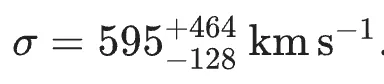
这与由热压作用产生的炽热核心星系风一致。研究组表明,自由风模型能够准确再现测量的温度值,但低估了速度。从星核推算出的质量和能量外流速率约为7 M⊙ yr-1以及4×1042 erg s-1,这表明大部分超新星能量可通过热化过程释放。
这些外流速率所提供的能量足以驱动超过30 M⊙ yr-1的低温流出,并且还能向星际介质输送多达3 M⊙ yr -1的物质。这表明热气体压力足以驱动多相星系风,而无需额外的宇宙射线支持。研究组还发现,核区气体的温度和速度都高于在更大尺度上所观测到的等离子体——

这表明后者有着不同的起源。
▲ Abstract:
Starburst galaxies often host multiphase, galaxy-scale winds thought to enrich the circumgalactic medium and limit further star formation by disrupting interstellar gas clouds. These winds are primarily powered by supernovae, but it remains unclear how supernova energy forms an organized flow. Here we use the Resolve spectrometer on the X-ray Imaging and Spectroscopy Mission to show that the hot (T = 2 × 10⁷K gas in the nucleus of the starburst galaxy M82 is moving quickly, with a line-of-sight velocity dispersion.

This is consistent with a hot, nuclear wind generated by thermal pressure. We show that a free-wind model reproduces the measured temperature but underpredicts the velocity. The inferred mass and energy outflow rates from the nucleus, about 7 M⊙ yr-1 and 4 × 1042 erg s-1, require that most supernova energy is thermalized. These outflow rates provide enough energy to power the 30 M⊙ yr-1cool outflow and still transport up to 3 M⊙ yr-1 to the intergalactic medium, suggesting that thermal gas pressure is sufficient to power the multiphase wind without additional support from cosmic rays. We also show that the nuclear gas is hotter and faster than the plasma seen on larger scales,
suggesting a distinct origin for the latter.
人工智能Artificial Intelligence
Towards end-to-end automation of AI research
迈向人工智能研究的端到端自动化
▲ 作者:Chris Lu, Cong Lu, Robert Tjarko Lange, Yutaro Yamada, Shengran Hu, Jakob Foerster, et al.
▲链接:
https://www.nature.com/articles/s41586-026-10265-5
▲摘要:
科研自动化是人工智能(AI)研究领域的一项长期目标。尽管学界在将科研流程的各个环节自动化方面取得了显著进展,但能够自主完成从构思到发表全周期研究论文的系统却仍未实现。
研究组展示了一个能够将整个科研流程端到端实现自动化的流程框架,推出了“AI科学家”这一系统。它能够创造研究思路、编写代码、进行实验、绘制图表并分析数据、撰写完整科研论文,并进行自我同行评审。
其研究思路、执行方式和呈现效果都达到标准,以至于由该AI系统生成的稿件成功通过了某顶级机器学习会议研讨会的第一轮同行评审。该研讨会的录用率为70%。
该系统将现代基础模型融入到一个复杂的智能体架构中。研究组对“AI科学家”进行了两种情况下的评估:一种是采用人类提供的代码模板作为初始框架,以开展特定主题研究的的聚焦模式;另一种是利用智能体搜索来进行更广泛科学探索的无模板、开放端模式。
这两种模式都能产生多样化的思路,并自动对其进行测试、报告和评估。这一成就表明了AI做出科学贡献的能力不断增强,并预示着科研范式可能发生的重大变革。
与任何具有重大影响的新技术一样,该系统也可能存在一些重要风险,比如给不堪重负的评审体系带来负担,以及给科学文献增添杂乱因素。然而,如果能负责任地开发,这类自主系统能够极大地加速科学发现进程。
▲ Abstract:
The automation of science is a long-standing ambition in artificial intelligence (AI) research. Although the community has made substantial progress in automating individual components of the scientific process, a system that autonomously navigates the entire research life cycle—from conception to publication—has remained out of reach. Here we present a pipeline for automating the entire scientific process end to end. We present The AI Scientist, which creates research ideas, writes code, runs experiments, plots and analyses data, writes the entire scientific manuscript, and performs its own peer review. Its ideas, execution and presentation are of sufficient quality that the manuscript generated by this AI system passed the first round of peer review for a workshop of a top-tier machine learning conference. The workshop had an acceptance rate of 70%. Our system leverages modern foundation models within a complex agentic system. We evaluate The AI Scientist in two settings: a focused mode using human-provided code templates as an initial scaffold for conducting research on a specific topic and a template-free, open-ended mode that leverages agentic search for wider scientific exploration. Both settings produce diverse ideas and automatically test, report on and evaluate them. This achievement demonstrates the growing capacity of AI for making scientific contributions and signifies a potential paradigm shift in how research is conducted. As with any impactful new technology, there could be important risks, including taxing overwhelmed review systems and adding noise to the scientific literature. However, if developed responsibly, such autonomous systems could greatly accelerate scientific discovery.
物理学Physics
Magnetic resonance control of spin-correlated radical pair dynamics in vivo
体内磁共振调控自旋相关自由基对动力学
▲ 作者:Shaun C. Burd, Nahal Bagheri, Alec F. Condon, Maria Ingaramo, Samsuzzoha Mondal, Dara P. Dowlatshahi, et al.
▲链接:
https://www.nature.com/articles/s41586-026-10282-4
▲摘要:
磁场能够影响那些涉及自旋相关自由基对(SCRPs)的反应。这为静态磁场和时变磁场能在生物分子层面影响生物体提供了一种机制。
然而,尚未有研究证明,工程化的SCRP系统可对多细胞生物体的非天然生化过程具有磁敏感性。
研究组展示了在活体转基因动物中使用磁共振调控SCRP动力学。结果发现,在存在黄素辅因子的情况下,各种红色荧光蛋白(RFP)的发光现象可通过在电子自旋共振频率附近施加静态磁场和射频磁场的方式进行调控。
这一效应在室温条件下通过体外实验以及转基因秀丽隐杆线虫(经过基因改造以表达RFP-mScarlet)体内实验均得到了证实。
这些观测结果表明,在RFP-黄素系统中所测量到的磁场效应由相干时间大于4纳秒的量子关联自由基对引发。
该实验证实,射频磁场能够影响体内涉及SCRPs的反应动力学,这有望为远程调控生物分子过程(如基因表达)提供新方法,并展现了量子工具在生物学领域具有更广泛的应用潜力。
▲ Abstract:
Magnetic fields can influence reactions involving spin-correlated radical pairs (SCRPs). This provides a mechanism by which both static and time-varying magnetic fields can affect living systems at the biomolecular level. However, an engineered SCRP system conferring magnetic sensitivity to a non-native biochemical process in a multicellular organism has not yet been demonstrated. Here we demonstrate control of SCRP dynamics using magnetic resonance in a live transgenic animal. We show that the emission of various red fluorescent proteins (RFPs), in the presence of a flavin cofactor, can be modified by a combination of static and radiofrequency magnetic fields applied near the electron spin resonance frequency. This effect was measured at room temperature both in vitro and in the nematode Caenorhabditis elegans, genetically modified to express the RFP mScarlet. These observations suggest that the magnetic field effects measured in RFP-flavin systems are due to quantum-correlated radical pairs with a coherence time larger than 4 ns. Our experiments demonstrate that radiofrequency magnetic fields can influence dynamics of reactions involving SCRPs in vivo, potentially enabling new methods for remotely controlling biomolecular processes, such as gene expression, and suggest broader potential for quantum tools in biology.
材料科学Materials Science
Pivoting colloidal assemblies exhibit mechanical metamaterial behaviour
集成忆阻器助力缓解钙钛矿太阳能电池反向偏压
▲ 作者:Mahdi Mohammadi, Fuxiang Ji, Tristan Sachsenweger, Kazem Meraji, Sharun Parayil Shaji & Wolfgang Tress
▲链接:
https://www.nature.com/articles/s41586-026-10275-3
▲摘要:
钙钛矿太阳能电池(PSCs)的功率转换效率可与现有技术相媲美,加之其多功能性、低成本以及节能制造工艺,对于未来光伏技术具有巨大的潜力。
然而,PSC在适度反向偏压下并不稳定,这种情况在实际运行中不可避免,例如器件部分遮挡或采用PSC串联安装,较易导致反向偏压。
解决这一问题的方法主要集中在对器件架构进行设计改良,以提高击穿电压并减轻反向偏压带来的不良影响。
研究组提出了一种全新的解决方案,可彻底解决反向偏压的问题。他们提出Memsol这一全新概念,将忆阻器与太阳能电池集成为一体,既能保护太阳能电池,又能起到旁路元件的作用。忆阻器通过在特定区域沉积额外的金属-绝缘体堆叠来实现,并与太阳能电池部分共用钙钛矿材料和电极。
反向偏压和遮光测试表明,Memsol能保持稳定状态,并会根据光照和偏压条件在低电阻旁路状态和全效率太阳能电池运行状态之间自动切换。
研究组预期,其在实验室中展示的由九个电池单元组成串式结构的Memsol概念,有望被应用于大规模组件中,从而加快其商业化进程,且不再需要外接旁路二极管。
▲ Abstract:
Perovskite solar cells (PSCs) with power-conversion efficiencies comparable to established technologies hold huge promise for becoming the future photovoltaic technology, also given their versatility, low-cost and energy-efficient fabrication processes. However, PSCs are not stable under moderate reverse bias, an unavoidable situation under real-world operation, for instance, caused by partial shading of a module or installation with PSCs connected in series. Approaches to address this issue have focused on engineering the device architecture to enhance the breakdown voltage and mitigate the detrimental effects of reverse bias. Here we present a completely different approach that fully solves the reverse-bias issue. With our Memsol, we developed a new concept of a solar cell with an integrated memristor, which protects the solar cell and simultaneously works as a bypass element. The memristor is realized by area-selective deposition of an additional metal–insulator stack and shares the perovskite and electrodes with the solar-cell part. Reverse-bias and shading tests show that the Memsol remains stable and automatically toggles between a low-resistance bypass state and full-efficiency solar-cell operation, dependent on the illumination and bias conditions. We anticipate that our Memsol concept, which we demonstrated on a nine-cell string in the lab, will be implemented in large-scale modules, accelerating their commercialization and potentially making external bypass diodes unnecessary.
地球科学Earth Science
Moderate global warming does not rule out extreme global climate outcomes
温和全球升温并不能排除全球极端气候状况的可能性
▲ 作者:Emanuele Bevacqua, Erich Fischer, Jana Sillmann & Jakob Zscheischler
▲链接:
https://www.nature.com/articles/s41586-026-10237-9
▲摘要:
有效传达全球未来气候的最坏情景预测(以下简称“最坏气候结果”)对于风险评估以及制定应对全球升温的稳健适应策略至关重要。
然而,目前用于确定空间一致性气候结果的方法存在局限性。最糟糕的全球气候状况通常是通过在高全球升温水平(如比工业化前时期高出3℃或4℃)下气候模型预测的平均值来呈现。
研究组表明,即便在2℃中等升温情景下,某些区域的全球极端气候状况仍有可能出现。
对于全球主要粮食产区的干旱情况、人口密集地区的极端降水情况以及森林地区的极端火灾而言,在全球升温2℃的情况下,全球气候影响驱动因素的强度可能会比在升温3℃或4℃时的模型平均预测结果更为极端。
研究组通过在全球关键区域对与特定行业相关的气候影响驱动因素进行空间平均处理,确定了特定行业、空间一致的潜在高影响和低影响的全球气候结果,并得出上述结论。该方法可便捷应用于众多领域,助力提升特定行业的气候风险评估,并为气候政策提供参考依据。
随着全球升温逼近1.5℃,这些发现凸显了迅速采取减排措施以将升温幅度控制在2℃以下的紧迫性。因为即便仅升温2℃,也可能带来严重的后果。
▲ Abstract:
Effectively communicating worst-case projections of global future climate—hereinafter referred to as worst-case climate outcomes—is essential for risk assessment and developing robust adaptation strategies to global warming. Yet, current approaches for identifying spatially consistent climate outcomes are limited, with worst-case global climates typically communicated via the average of climate model projections at high global warming levels, such as 3 °C or 4 °C above the preindustrial era. Here we show that extreme global climate outcomes may occur even under moderate 2 °C warming for several sectors. For droughts in global key breadbasket regions, precipitation extremes over highly populated areas and fire weather extremes across forests, global climatic impact-drivers at 2 °C of global warming may turn out to be much more extreme than model-averaged projections at 3 °C or 4 °C warming. We derive these results by identifying sector-specific, spatially consistent potential high- and low-impact global climate outcomes through spatially averaging projected sector-relevant climatic impact-drivers across key global regions. Our approach can easily be adapted to a wide range of sectors to support the improvement of sector-specific climate risk assessment and to inform climate policy. As global warming approaches 1.5 °C, these findings underscore the urgency of rapid mitigation to limit warming well below 2 °C, as even a 2 °C world may entail severe impacts.
CO2 subsurface mineral storage by its co-injection with recirculating water
二氧化碳与循环水共注入地下实现碳矿化封存
▲ 作者:GEric H. Oelkers, Serguey Arkadakskiy, Zeyad Ahmed, Noushad Kunnummal, Jakub Fedorik, Massimo Marchesi, et al.
▲链接:
https://www.nature.com/articles/s41586-026-10130-5
▲摘要:
碳捕获与碳封存(CCS)技术有望帮助各国实现其在《巴黎协定》中所作出的二氧化碳减排承诺。
通过碳矿化作用在镁铁质和超镁铁质岩石中捕获二氧化碳的能力,就是此类CCS技术的一个实例,但大规模应用尚未实现。
地壳中的不同地质环境都需要独特的碳封存方案。而某些地下区域确实存在含盐含水层和适合传统碳储存的沉积圈闭,可通过在不渗透的盖层之下注入高压、致密的二氧化碳来实现碳储存;但其他区域可能缺乏这样的不渗透盖层。
在这些地区,可通过注入水溶解的二氧化碳,使其与具有反应性的硅酸盐岩石和矿物质发生反应,从而形成稳定碳酸盐矿物的矿化过程来实现碳封存。
大规模应用该工艺面临一个显著挑战,其耗水量可能比所储存的二氧化碳总质量高出20~50倍甚至更多。
研究组报道了一个旨在为沙特西部寻找碳排放处理方案的工业规模试点项目。这个干旱地区有大量的点源二氧化碳排放源,比如石油精炼厂和海水淡化厂,但缺乏含盐含水层和沉积圈闭。
研究组发现,基于地下流体再循环的二氧化碳注入方法可摆脱对外部水源的依赖。研究结果表明,在水资源供应有限地区,利用碳矿化进行碳封存是可行的。
▲ Abstract:
ICarbon capture and storage (CCS) has the potential to help nations meet their Paris Agreement CO2 reduction commitments. The ability to capture CO2 within mafic and ultramafic rocks through mineralization of carbon is an example of such a CCS technology, but large-scale deployment has yet to be achieved. Each geologic environment in the Earth’s crust requires a distinct carbon storage solution. Whereas some regions of the subsurface contain saline aquifers and sedimentary traps suitable for traditional carbon storage through the injection of high-pressure, dense CO2 below impermeable caprocks, other regions may lack caprocks. In these regions, carbon storage is possible through the mineralization of injected water-dissolved CO2 forming stable carbonate minerals through its reactions with reactive silicate rocks and minerals. A notable challenge to applying this process at scale is that it can require 20–50 times or more water than the mass of CO2 stored. Here we report on an industrial-scale pilot project designed to find a carbon disposal solution for western Saudi Arabia. This arid region has large point-source CO2 emitters, including petroleum refining and desalination facilities, but lacks saline aquifers and sedimentary traps. We find that a CO2 injection approach based on the recirculation of subsurface fluids can eliminate the need for external water. Our results demonstrate the feasibility of carbon mineral storage in regions in which access to water resources may be limited.
特别声明:本文转载仅仅是出于传播信息的需要,并不意味着代表本网站观点或证实其内容的真实性;如其他媒体、网站或个人从本网站转载使用,须保留本网站注明的“来源”,并自负版权等法律责任;作者如果不希望被转载或者联系转载稿费等事宜,请与我们接洽。