
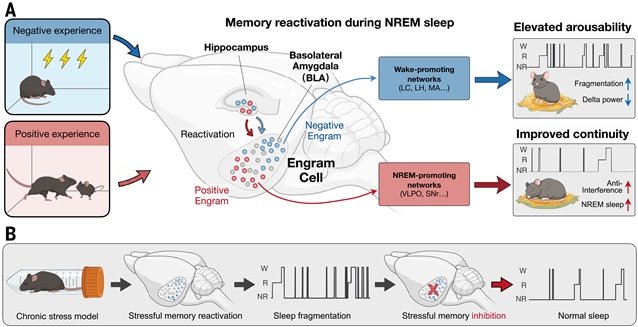
通过跟踪和调节小鼠睡眠期间的记忆活动,研究人员发现消极记忆再激活促进芳香性,而积极记忆支持睡眠稳定性。这种调节是通过睡眠期间体验特异性海马体-杏仁核印痕回路的再激活介导的。在慢性应激模型中,负性记忆再激活促进睡眠障碍,而有针对性地抑制记忆再激活恢复正常睡眠。他们的发现建立了一种依赖记忆的睡眠调节,在这种调节中,记忆再激活与对特定记忆内容作出反应的下游回路有关。
据了解,最近的记忆在睡眠中通过自发的再激活得到巩固。然而,记忆再激活是否以及如何影响睡眠动态仍然不清楚。
附:英文原文
Title: Memory reactivation underlies experience-dependent adaptive regulation of sleep
Author: Menghan Yu, Junjie Wang, Zihan Zhai, Ruoyi Huang, Guofan Fan, Xiaoya Su, Yijun Niu, Haochen Zhu, Jiayi Chen, Grace Jiang, Tian Zhang, Yi Zhong, Bo Lei
Issue&Volume: 2026-06-04
Abstract: Recent memories are consolidated during sleep by spontaneous reactivation. However, whether and how memory reactivation affects sleep dynamics remain unclear. By tracking and modulating memory activity during sleep in mice, we revealed that negative memory reactivation promoted arousal, whereas positive memory supported sleep stability. This regulation was mediated by the reactivation of experience-specific hippocampus-amygdala engram circuits during sleep. In chronic stress models, negative memory reactivation promoted sleep disturbance, and targeted suppression of memory reactivation restored normal sleep. Our findings establish a memory-dependent sleep regulation in which memory reactivation engages downstream circuits responsive to specific memory content.
DOI: aed8630
Source: https://www.science.org/doi/10.1126/science.aed8630