
魏茨曼科学研究所Nachum Ulanovsky课题组近日取得一项新成果。经过不懈努力,他们的研究发现海马区CA3和CA1之间的稀疏到密集编码转换。相关论文发表在2026年5月27日出版的《自然》杂志上。
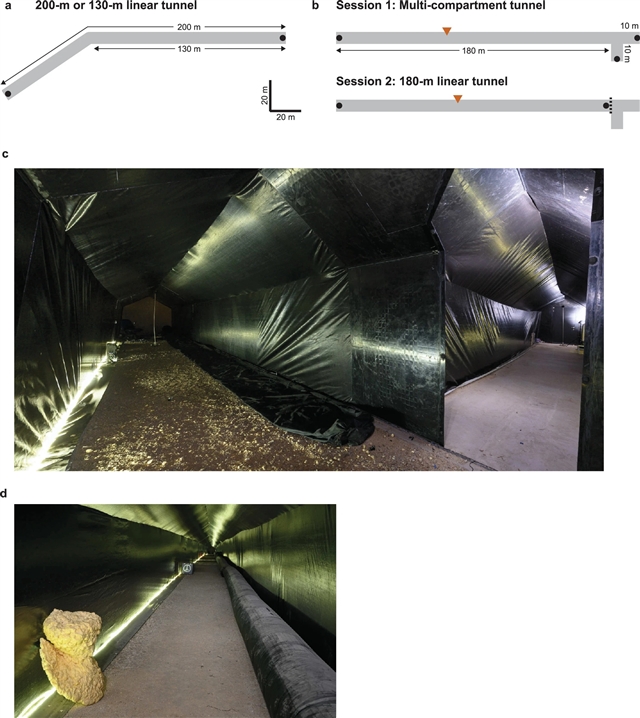
在这里,该课题组研究人员假设CA1和CA3空间编码之间缺乏差异是由于实验范式:主题化小领域。该研究团队通过在长达200米的飞行隧道中同时记录蝙蝠的CA1和CA3神经元来验证这一假设。小组在CA1和CA3中发现了高度不同的神经编码:CA1神经元表现出密集的空间编码,由多个位置场组成,而CA3神经元表现出超解析的空间编码,主要由单个位置场组成。尽管存在这种显著差异,但两个子区域之间的位置场大小非常相似,跨越5种不同的环境大小,范围从6米到200米。
使用神经网络模型,研究人员证明了这种稀疏到密集的转换可以促进新的空间地图的快速学习。该课题组还发现,在大型多室环境中,位置细胞受到轨迹历史的强烈调节,这是一种可能持续超过100 μm的上下文效应(回顾性编码)。通过对大型自然环境进行主题化,该团队确定了CA3到CA1的编码转换,该转换有助于将空间信息重新格式化为更有效的压缩神经代码。
据了解,海马体对空间记忆和导航至关重要。它包含位置细胞:在CA1和CA3区发现的空间选择性神经元-这是两个不同的海马亚区,具有本质上不同的解剖连接。先前的研究发现CA1和CA3位置细胞之间的空间编码高度相似。这就提出了一个问题:为什么形成连续处理阶段的两个子区域会表现出相同的神经编码。
附:英文原文
Title: Sparse-to-dense coding transformation between hippocampal areas CA3 and CA1
Author: Maimon, Shir R., Eliav, Tamir, Aljadeff, Johnatan, Shalev, Aviya, Gronich, Yishai, Finger, Nikita M., Eveland, Keegan E., Moss, Cynthia F., Las, Liora, Ulanovsky, Nachum
Issue&Volume: 2026-05-27
Abstract: The hippocampus is crucial for spatial memory and navigation. It contains place cells1,2,3,4,5,6,7: spatially selective neurons found in areas CA1 and CA3—two distinct hippocampal subregions with substantially different anatomical connectivity8. Previous studies have found highly similar spatial coding between CA1 and CA3 place cells3,9,10,11. This raises the question of why two subregions that form consecutive processing stages would exhibit identical neural coding. Here we hypothesized that the lack of differences between CA1 and CA3 spatial coding is due to the experimental paradigm: using small arenas. We tested this hypothesis by simultaneously recording from CA1 and CA3 neurons in bats flying in flight tunnels up to 200m in length. We identified highly distinct neural coding in CA1 and CA3: whereas CA1 neurons exhibited dense spatial coding, consisting of multiple place fields12, CA3 neurons exhibited ultrasparse spatial coding, consisting predominantly of single place fields. Despite this marked difference, the sizes of place fields were very similar between the two subregions, across 5 different environment sizes ranging from 6m to 200m. Using a neural-network model, we show that such a sparse-to-dense transformation can facilitate fast learning of new spatial maps. We also found that in a large multicompartment environment, place cells were strongly modulated by trajectory history—a contextual effect (retrospective coding) that could last for over 100m. Together, by using large naturalistic environments, we identified a CA3-to-CA1 coding transformation that serves to reformat spatial information into a more efficient, compressed neural code.
DOI: 10.1038/s41586-026-10537-0
Source: https://www.nature.com/articles/s41586-026-10537-0
Nature:《自然》,创刊于1869年。隶属于施普林格·自然出版集团,最新IF:69.504
官方网址:http://www.nature.com/
投稿链接:http://www.nature.com/authors/submit_manuscript.html