
近日,美国加州大学洛杉矶分校B. Kuhasubpasin团队报道了构造岩石损伤在侵蚀过程中的作用:全球分析。2026年5月21日出版的《科学》杂志发表了这项成果。
活动断层在驱动岩石抬升中的作用众所周知,但其对岩石损伤和侵蚀效率的影响在全球范围内尚不明确。
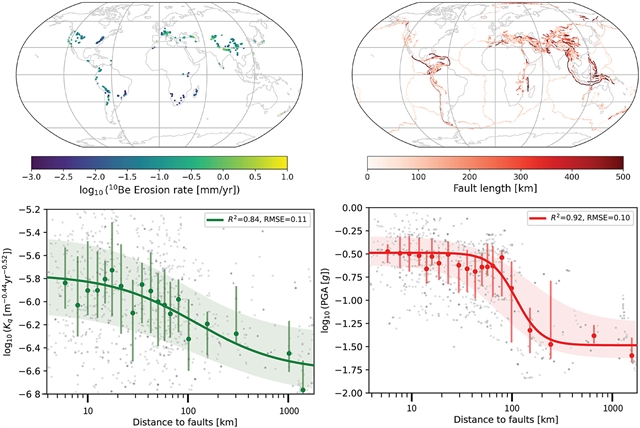
利用1744个基于铍-10(10Be)的侵蚀速率数据,研究组发现,在断层迹线约15公里范围内,侵蚀效率平均升高,并随距离增加而下降,影响范围可达约100公里。逆断层以及长度超过140公里的断层表现出最强的效应。这种随距离衰减的尺度表明,构造损伤不仅限于主干断层的断层核粉碎,还可能包括地震震动及复杂断层网络上的分布式变形所导致的破裂或颗粒间接触弱化。
机器学习分析表明,断层邻近度是控制侵蚀效率的主导因素,其重要性超过降水和岩性,尤其在纳入地震震动指标时更为明显。这些发现指出,活动构造不仅通过抬升作用影响侵蚀,还通过远程岩石损伤增强侵蚀效率。
附:英文原文
Title: Role of tectonic rock damage in erosional processes: A global analysis
Author: B. Kuhasubpasin, S. Moon, C. Lithgow-Bertelloni
Issue&Volume: 2026-05-21
Abstract: The role of active faults in driving rock uplift is well known, but their influence on rock damage and erosional efficiency remains unclear globally. Using 1744 beryllium-10 (10Be)–derived erosion rates, we show that erosional efficiency is elevated on average within ~15 kilometers of a fault trace and decreases with distance, up to ~100 kilometers. Reverse faults and those longer than 140 kilometers show the strongest effects. This length scale of decay suggests that tectonic damage extends beyond fault-core pulverization on primary faults, possibly including fracturing or grain-to-grain contact weakening due to seismic shaking and distributed deformation on complex fault networks. Machine learning identified fault proximity as a dominant control on erosional efficiency, exceeding precipitation and lithology, particularly when a measure of seismic shaking is included. These findings indicate that active tectonics are associated with erosion not only through uplift but also by enhancing erosional efficiency through long-range rock damage.
DOI: ady9857
Source: https://www.science.org/doi/10.1126/science.ady9857