
近日,美国得克萨斯大学奥斯汀分校睢鑫昕团队报道了发散型城市风暴对对流、锋面和热带系统的响应。该项研究成果发表在2026年5月20日出版的《自然》杂志上。
城市化会改变降水模式,但以往研究报道的结果并不一致:有的城市降雨增强,有的则受到抑制。
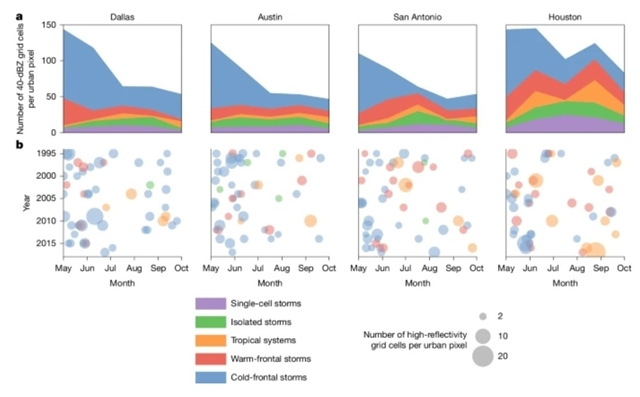
为了调和这些差异,研究组通过基于事件的分析,研究了城市影响如何随风暴类型而变化。利用三维雷达反射率数据(1995-2017年),研究组在德克萨斯州的四个城市(达拉斯、奥斯汀、圣安东尼奥和休斯顿)识别了超过40,000场暖季风暴。研究表明,将风暴分为五种类型,可以揭示与风暴尺度和动力学相关的不同城市影响。由大气不稳定性驱动的局地尺度单细胞风暴和孤立风暴,其发生频率增加了7%-31%,尤其是在夜间。
天气尺度锋面风暴的发生频率未见变化,但强度响应截然相反:冷锋经过城市时强度减弱了16%-28%,这很可能是由于热力和粗糙度效应所致;而暖锋的反射率则有所增强。热带气旋系统在频率或强度上没有一致的变化,但在城市区域,高反射率网格单元呈现出向更低海拔偏移的趋势。鉴于德克萨斯州多样化的气候和地理条件,这项工作为理解其他地区的城市-风暴相互作用提供了一个可迁移的框架。这些发现超越了传统的“城市干/湿岛”模型,深化了研究组对城市化如何调节极端降水的理解,并为气候模拟及快速扩张城市的韧性规划提供了参考。
附:英文原文
Title: Divergent urban storm response to convective, frontal and tropical systems
Author: Sui, Xinxin, Nielsen-Gammon, John, Yang, Zong-Liang, Niyogi, Dev
Issue&Volume: 2026-05-20
Abstract: Urbanization modifies precipitation1,2, yet previous studies have reported inconsistent results, with some cities experiencing rainfall enhancement and others showing suppression3. To reconcile these discrepancies, we examine how urban impacts vary across storm types using an event-based analysis. With three-dimensional radar reflectivity data (1995–2017), we identify more than 40,000 warm-season storms across four Texas cities (Dallas, Austin, San Antonio and Houston). Here we show that classifying storms into five types reveals distinct urban influences linked to storm scales and dynamics. Local-scale single-cell and isolated storms, driven by atmospheric instability, increase in frequency (7–31%), particularly at night. Synoptic-scale frontal storms show unchanged occurrence but contrasting intensity responses: cold fronts weaken over cities by 16–28%, probably because of thermal and roughness effects, whereas warm fronts exhibit enhanced reflectivity. Tropical systems show no consistent change in frequency or intensity but exhibit a shift of high-reflectivity grid cells towards lower altitudes over urban areas. Given the diverse climate and geography of Texas, this work provides a transferable framework for understanding urban–storm interactions in other regions. These findings move beyond the traditional ‘urban wet or dry islands’ model, advancing our understanding of how urbanization modulates extreme precipitation and informing climate modelling4,5 and resilience planning for rapidly growing cities6,7.
DOI: 10.1038/s41586-026-10479-7
Source: https://www.nature.com/articles/s41586-026-10479-7
Nature:《自然》,创刊于1869年。隶属于施普林格·自然出版集团,最新IF:69.504
官方网址:http://www.nature.com/
投稿链接:http://www.nature.com/authors/submit_manuscript.html